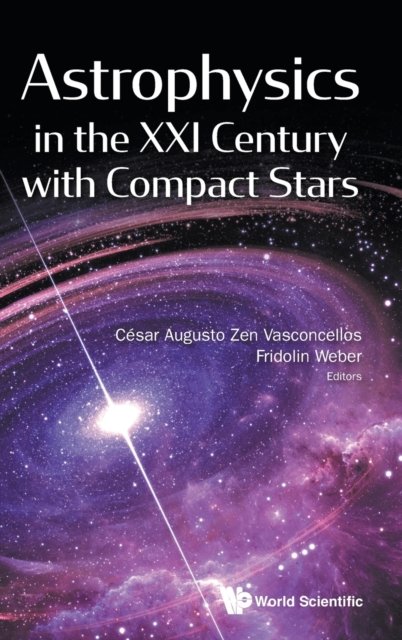
Astrophysics In The Xxi Century With Compact Stars
Redigert av Cesar Augusto Zen , Brazil & International Center For Relativistic Astrophysics Network (Icranet), , Fridolin , Usa & University Of California At San Diego (Ucsd), Usa) Weber, 2022.
There are reasons to believe the 21st century will be the best ever for astrophysics: the James Webb Space Telescope will extend nearly twenty times the present observational limit of visible light; neutrino massiveness opens a new window for exploration on dark energy and dark matter physics and is expected to provide insights into the fate of the Universe; the Higgs boson may allow for an understanding of the weakness of gravity; gravitational waves produced at the birth of the Universe and by compact stellar objects (supermassive black holes, black hole/neutron star mergers, gamma-ray bursts, white dwarf inspirals) have unveiled a new area of astronomy. Against this background, compact stars, the theme of this volume, present unique astrophysical laboratories for probing the fabric of space-time and the building blocks of matter and their interactions at physical regimes not attainable in terrestrial laboratories.
Språk: Engelsk
Oppdag mer
Astrophysics In The Xxi Century With Compact Stars
Redigert av Cesar Augusto Zen , Brazil & International Center For Relativistic Astrophysics Network (Icranet), , Fridolin , Usa & University Of California At San Diego (Ucsd), Usa) Weber, 2022.
There are reasons to believe the 21st century will be the best ever for astrophysics: the James Webb Space Telescope will extend nearly twenty times the present observational limit of visible light; neutrino massiveness opens a new window for exploration on dark energy and dark matter physics and is expected to provide insights into the fate of the Universe; the Higgs boson may allow for an understanding of the weakness of gravity; gravitational waves produced at the birth of the Universe and by compact stellar objects (supermassive black holes, black hole/neutron star mergers, gamma-ray bursts, white dwarf inspirals) have unveiled a new area of astronomy. Against this background, compact stars, the theme of this volume, present unique astrophysical laboratories for probing the fabric of space-time and the building blocks of matter and their interactions at physical regimes not attainable in terrestrial laboratories.
Oppdag mer
Språk: Engelsk
Ved å fullføre kjøpet aksepterer du kjøpsvilkårene.