Dagmar Varady
Av Dagmar Varady, Paolo Bianchi, 2023.
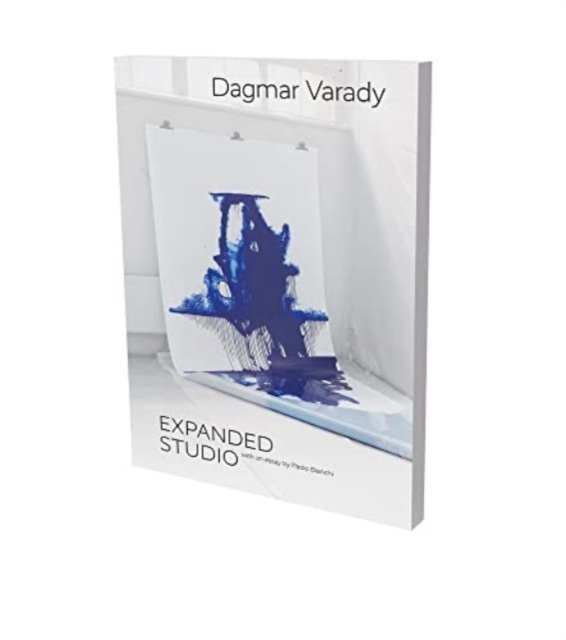
After World War II, the white cube acquired the status of an aesthetic convention. Dagmar Varady? s studio, impressively presented in the book, though seems to be a place where art is produced and also an ? exhibition space? . Rather than being viewed as completed works or paintings, her works are ? permanently in motion? , as the artist emphasizes. Thus, in the studio, a personal (knowledge) order emerges in the context of art, something along the lines of ? principles in chaos? , whereby guided chance (serendipity) also comes into play, which is quite evident in the structures, folds, and progressions in her series of ? Brilliant-Blue? paintings. With all the breaks, deviations, intuitions, exceptions, and ambiguities that occur in her art, Dagmar Varady has set out on the ? path of unintentionality? (Ernst Bloch) ? an unintentionality that promotes the processuality of art, but which in turn would not come about without a steady place of production, the studio. There, motifs meander from picture to picture in an indeterminate production process, enter into dialogue with one another, and undergo a protean transformation into ever new variants. As such, Dagmar Varady? s studio is not simply a place of work but, in the artist? s own words, her ? navel to the world? and, as such, a kind of laboratory in which intrinsic processes play a significant role in determining artistic attitudes and objectives.
Ved å fullføre kjøpet aksepterer jeg kjøpsvilkårene.
Ikke tilgjengelig for Klikk&Hent
På nettlager. Bestilles fra England. Leveres normalt innen 5-8 virkedager.
Oppdag mer
Dagmar Varady
Av Dagmar Varady, Paolo Bianchi, 2023.
After World War II, the white cube acquired the status of an aesthetic convention. Dagmar Varady? s studio, impressively presented in the book, though seems to be a place where art is produced and also an ? exhibition space? . Rather than being viewed as completed works or paintings, her works are ? permanently in motion? , as the artist emphasizes. Thus, in the studio, a personal (knowledge) order emerges in the context of art, something along the lines of ? principles in chaos? , whereby guided chance (serendipity) also comes into play, which is quite evident in the structures, folds, and progressions in her series of ? Brilliant-Blue? paintings. With all the breaks, deviations, intuitions, exceptions, and ambiguities that occur in her art, Dagmar Varady has set out on the ? path of unintentionality? (Ernst Bloch) ? an unintentionality that promotes the processuality of art, but which in turn would not come about without a steady place of production, the studio. There, motifs meander from picture to picture in an indeterminate production process, enter into dialogue with one another, and undergo a protean transformation into ever new variants. As such, Dagmar Varady? s studio is not simply a place of work but, in the artist? s own words, her ? navel to the world? and, as such, a kind of laboratory in which intrinsic processes play a significant role in determining artistic attitudes and objectives.
Oppdag mer
Ved å fullføre kjøpet aksepterer jeg kjøpsvilkårene.
Ikke tilgjengelig for Klikk&Hent
På nettlager. Bestilles fra England. Leveres normalt innen 5-8 virkedager.
Ved å fullføre kjøpet aksepterer du kjøpsvilkårene.