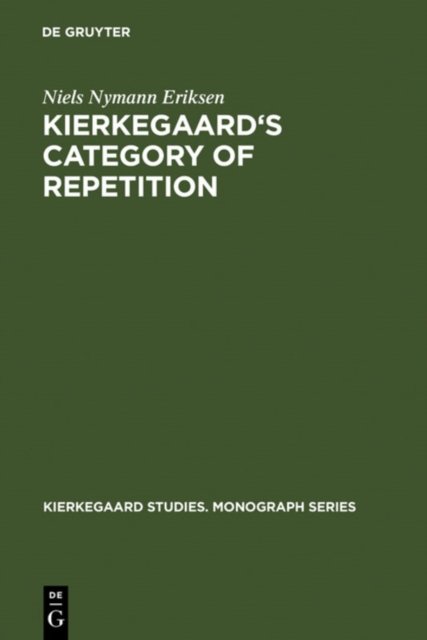
Kierkegaard''s Category of Repetition
Av Niels Nymann Eriksen, 2000.Del av serien Kierkegaard Studies. Monograph Series.
A Reconstruction
In der Geschichte der Kierkegaard-Rezeption haben die pseudonymen Werke stets im Mittelpunkt der Forschung gestanden. Der vorliegende Band des Yearbook widmet sich nun auch der vernachlässigten Seite des Kierkegaardschen Werkes. In seinem Zentrum stehen die erbaulichen Reden von 1843-44 sowie die Drei Reden bei gedachten Gelegenheiten von 1845, die unter literaturwissenschaftlicher, philosophischer, theologischer und rezeptionsgeschichtlicher Perspektive betrachtet werden.
Ikke tilgjengelig for Klikk&Hent
Midlertidig tomt på lager
Bestillingsvare. Forventes sendt om ca 14 dager
Kierkegaard''s Category of Repetition
Av Niels Nymann Eriksen, 2000.Del av serien Kierkegaard Studies. Monograph Series.
A Reconstruction
In der Geschichte der Kierkegaard-Rezeption haben die pseudonymen Werke stets im Mittelpunkt der Forschung gestanden. Der vorliegende Band des Yearbook widmet sich nun auch der vernachlässigten Seite des Kierkegaardschen Werkes. In seinem Zentrum stehen die erbaulichen Reden von 1843-44 sowie die Drei Reden bei gedachten Gelegenheiten von 1845, die unter literaturwissenschaftlicher, philosophischer, theologischer und rezeptionsgeschichtlicher Perspektive betrachtet werden.
Ikke tilgjengelig for Klikk&Hent
Midlertidig tomt på lager
Bestillingsvare. Forventes sendt om ca 14 dager
Ved å fullføre kjøpet aksepterer du kjøpsvilkårene.