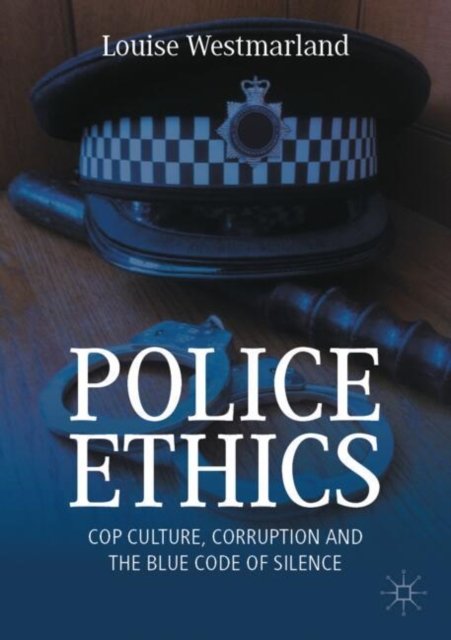
Police Ethics
Av Louise Westmarland, 2025.
Cop Culture, Corruption and the Blue Code of Silence
"This book is an important analysis of how police themselves define and respond to police corruption and wrongdoing. It offers special insights into this hard to research issue because it is based on using similar techniques of study on samples of police over time and in different jurisdictions, all linked by an autoethnographic account by Professor Westmarland?internationally celebrated expert on the topic?narrating her engagement with the problems of police corruption and culture. This provides a revealing account of variations over time and between places. Clearly and engagingly written this is essential reading for students, scholars, practitioners and policy makers concerned about policing and its legitimacy."
-Professor Robert Reiner, Emeritus Professor of Criminology, LSE
This is a lively and fascinating book which places our understanding of policing ethics, integrity and police corruption within a long term timeline. The author traces how a particular research technique within policing studies - the use of 'scenario' based surveys of police officers to test officers' attitudes to the seriousness of a series of possible forms of police misconduct and their willingness to report those forms to others - has been utilised in policing research over a 50 plus year history. It begins with US-based pioneering policing research in the 1970s and takes us through the use of, and lessons learnt by, scenario-based research in later decades in the UK and internationally. This includes, by way of an autoethnography, the author's own critical research over the past 20 years, revisiting some earlier published research on the theme. This book is essential reading for those studying police integrity and corruption and the wider field of police cultures. - Professor Steve Savage, Emeritus Professor of Criminology, University of Portsmouth.
Outlining over 20 years of in-depth research on police culture and the blue code of silence, this book draws upon first hand research with serving police officers and some support staff. These studies include analyses of recent (post 1950s) histories of police cultural research, concentrating on ethics and integrity, up to present day reflections on the UK College of Policing?s introduction of a code of ethics in 2014 and beyond. It asks whether anything has changed over the years, using relevant studies as examples, and what the potential lessons learnt are from the various scandals that have come to light. The questionnaires and research instruments used are included in the text for replication purposes, and alongside this the ethics of such studies are discussed. This book will speak to police officers including those enrolled on police degrees, policing scholars and students, and criminologists.
Ikke tilgjengelig for Klikk&Hent
Midlertidig tomt på lager
Bestillingsvare. Forventes sendt om ca 20 dager
Police Ethics
Av Louise Westmarland, 2025.
Cop Culture, Corruption and the Blue Code of Silence
"This book is an important analysis of how police themselves define and respond to police corruption and wrongdoing. It offers special insights into this hard to research issue because it is based on using similar techniques of study on samples of police over time and in different jurisdictions, all linked by an autoethnographic account by Professor Westmarland?internationally celebrated expert on the topic?narrating her engagement with the problems of police corruption and culture. This provides a revealing account of variations over time and between places. Clearly and engagingly written this is essential reading for students, scholars, practitioners and policy makers concerned about policing and its legitimacy."
-Professor Robert Reiner, Emeritus Professor of Criminology, LSE
This is a lively and fascinating book which places our understanding of policing ethics, integrity and police corruption within a long term timeline. The author traces how a particular research technique within policing studies - the use of 'scenario' based surveys of police officers to test officers' attitudes to the seriousness of a series of possible forms of police misconduct and their willingness to report those forms to others - has been utilised in policing research over a 50 plus year history. It begins with US-based pioneering policing research in the 1970s and takes us through the use of, and lessons learnt by, scenario-based research in later decades in the UK and internationally. This includes, by way of an autoethnography, the author's own critical research over the past 20 years, revisiting some earlier published research on the theme. This book is essential reading for those studying police integrity and corruption and the wider field of police cultures. - Professor Steve Savage, Emeritus Professor of Criminology, University of Portsmouth.
Outlining over 20 years of in-depth research on police culture and the blue code of silence, this book draws upon first hand research with serving police officers and some support staff. These studies include analyses of recent (post 1950s) histories of police cultural research, concentrating on ethics and integrity, up to present day reflections on the UK College of Policing?s introduction of a code of ethics in 2014 and beyond. It asks whether anything has changed over the years, using relevant studies as examples, and what the potential lessons learnt are from the various scandals that have come to light. The questionnaires and research instruments used are included in the text for replication purposes, and alongside this the ethics of such studies are discussed. This book will speak to police officers including those enrolled on police degrees, policing scholars and students, and criminologists.
Ikke tilgjengelig for Klikk&Hent
Midlertidig tomt på lager
Bestillingsvare. Forventes sendt om ca 20 dager
Ved å fullføre kjøpet aksepterer du kjøpsvilkårene.