Hopp til hovedinnholdet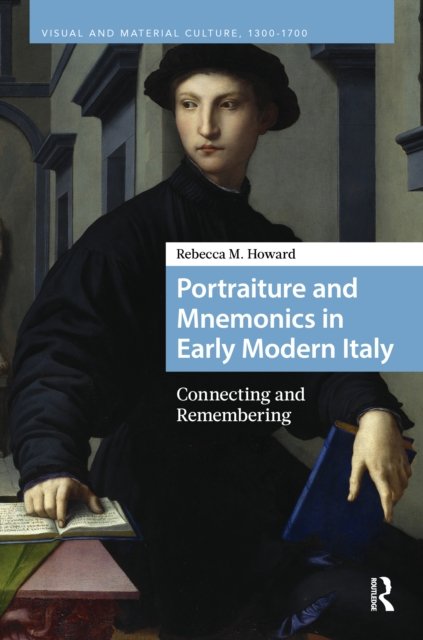
Portraiture and Mnemonics in Early Modern Italy
Av Rebecca M. Howard, 2026.Del av serien Visual and Material Culture, 1300-1700.
Connecting and Remembering
This book explores how certain early modern Italian portraits sought to directly engage the minds and memories of their viewers. Analyzing portraits made between the mid-Quattrocento and the mid-Cinquecento and by artists largely trained and working in the central and northern Italian peninsula, the case studies here demonstrate how these artworks succeeded in preserving both the external appearances and the inner qualities of their sitters. By examining specific portrait forms and compositional techniques, this book shows how several portrait types that gained popularity during this period were influenced by contemporary understandings of communication, identity, science of the brain, and mnemonic practices. These portraits were not merely visual representations but were deeply rooted in the intellectual and cultural frameworks of their time. Portraiture and Mnemonics in Early ModernItaly: Connecting and Remembering demonstrates that the impact of these portrait formats was twofold: they forged connections with viewers and incited said viewers to open their memory centers for mnemonic storage. Taking an interdisciplinary approach to the subject of early modern Italian portraiture, this book will be of interest to researchers studying history, studio art, literature, gender and identity studies, the humanities, science, and psychology.
InnbundetEngelsk
Butikkpris: 2 129,-
1 998,-
Ikke tilgjengelig for Klikk&Hent
Forhåndsbestill
Forventes i salg 31.07.2026
Portraiture and Mnemonics in Early Modern Italy
Av Rebecca M. Howard, 2026.Del av serien Visual and Material Culture, 1300-1700.
Connecting and Remembering
This book explores how certain early modern Italian portraits sought to directly engage the minds and memories of their viewers. Analyzing portraits made between the mid-Quattrocento and the mid-Cinquecento and by artists largely trained and working in the central and northern Italian peninsula, the case studies here demonstrate how these artworks succeeded in preserving both the external appearances and the inner qualities of their sitters. By examining specific portrait forms and compositional techniques, this book shows how several portrait types that gained popularity during this period were influenced by contemporary understandings of communication, identity, science of the brain, and mnemonic practices. These portraits were not merely visual representations but were deeply rooted in the intellectual and cultural frameworks of their time. Portraiture and Mnemonics in Early ModernItaly: Connecting and Remembering demonstrates that the impact of these portrait formats was twofold: they forged connections with viewers and incited said viewers to open their memory centers for mnemonic storage. Taking an interdisciplinary approach to the subject of early modern Italian portraiture, this book will be of interest to researchers studying history, studio art, literature, gender and identity studies, the humanities, science, and psychology.
Butikkpris: 2 129,-
1 998,-
InnbundetEngelsk
Ikke tilgjengelig for Klikk&Hent
Forhåndsbestill
Forventes i salg 31.07.2026
1 998,-
Ved å fullføre kjøpet aksepterer du kjøpsvilkårene.