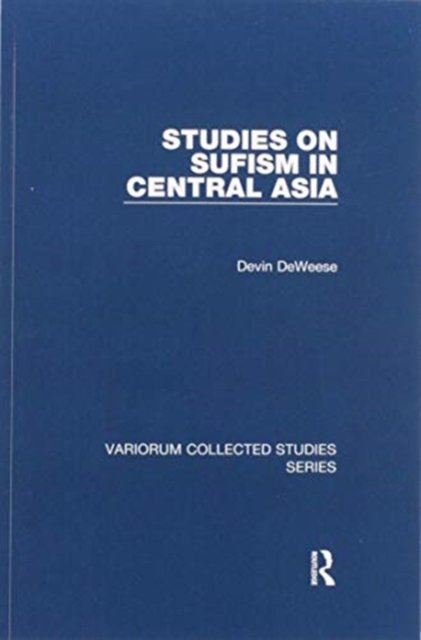
Studies on Sufism in Central Asia
Av Devin DeWeese, 2020.Del av serien Variorum Collected Studies.
Studies on Sufism in Central Asia reproduces 12 studies which explore previously unstudied sources with an eye to identifying prominent developments in the social and organizational history of the major Sufi groupings of the region; The chronological range reflected in the studies included here runs from the 13th century to the 17th, with a somewhat uneven distribution between the earlier half of the period (13th-15th centuries, with six articles, Nos. II, IV, V, VII, VIII, and XI) and the later half (16th-17th centuries, with four pieces, Nos. III, IX, X, XII), and two studies (Nos. I and VI) spanning the entire period. In terms of specific Sufi traditions, the studies included here reflect DeWeese?s attention to groups and individuals that might be identified (despite the focus of some of his more recent work on questioning the use and meaning of such labels) as KubravÄ«, YasavÄ«, and KhwÄjagÄnÄ«/NaqshbandÄ«, with four studies focused entirely on ?KubravÄ«? circles (Nos. I, II, V, XI), five on ?YasavÄ«? subjects (Nos. III, VII, IX, X, XII), and one on the KhwÄjagÄn (No. VIII), as well as one dealing with YasavÄ«-NaqshbandÄ« relations (No. VI) and another exploring a group that falls outside these labels (No. IV). KhwÄjagÄnÄ« and NaqshbandÄ« history has a strong ?background? presence, nevertheless, in five other articles (Nos. I, III, IV, VII, and IX), reflecting the steady rise of the NaqshbandÄ«ya to predominance among Central Asian Sufi traditions.
Ikke tilgjengelig for Klikk&Hent
Midlertidig tomt på lager
Bestillingsvare. Forventes sendt om ca 8 dager
Studies on Sufism in Central Asia
Av Devin DeWeese, 2020.Del av serien Variorum Collected Studies.
Studies on Sufism in Central Asia reproduces 12 studies which explore previously unstudied sources with an eye to identifying prominent developments in the social and organizational history of the major Sufi groupings of the region; The chronological range reflected in the studies included here runs from the 13th century to the 17th, with a somewhat uneven distribution between the earlier half of the period (13th-15th centuries, with six articles, Nos. II, IV, V, VII, VIII, and XI) and the later half (16th-17th centuries, with four pieces, Nos. III, IX, X, XII), and two studies (Nos. I and VI) spanning the entire period. In terms of specific Sufi traditions, the studies included here reflect DeWeese?s attention to groups and individuals that might be identified (despite the focus of some of his more recent work on questioning the use and meaning of such labels) as KubravÄ«, YasavÄ«, and KhwÄjagÄnÄ«/NaqshbandÄ«, with four studies focused entirely on ?KubravÄ«? circles (Nos. I, II, V, XI), five on ?YasavÄ«? subjects (Nos. III, VII, IX, X, XII), and one on the KhwÄjagÄn (No. VIII), as well as one dealing with YasavÄ«-NaqshbandÄ« relations (No. VI) and another exploring a group that falls outside these labels (No. IV). KhwÄjagÄnÄ« and NaqshbandÄ« history has a strong ?background? presence, nevertheless, in five other articles (Nos. I, III, IV, VII, and IX), reflecting the steady rise of the NaqshbandÄ«ya to predominance among Central Asian Sufi traditions.
Ikke tilgjengelig for Klikk&Hent
Midlertidig tomt på lager
Bestillingsvare. Forventes sendt om ca 8 dager
Ved å fullføre kjøpet aksepterer du kjøpsvilkårene.