Utopian Quest for a Pasigraphy
Av Edgar Walthert, 2025.
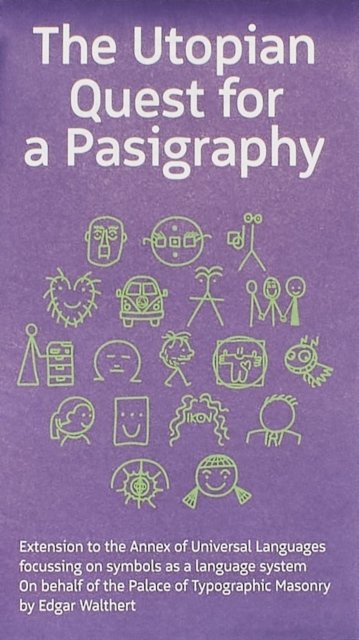
‘The Utopian Quest for a Pasigraphy’ is the newest addition to, the series of posters, initiated by the Palace ofTypographic Masonry, bringing both depth and breadth to the collection. A pasigraphy – derived from the Greekwords for ‘universal’ and ‘writing’ – is a system where symbols represent concepts, making it intelligible acrosslanguages. While icons like those found in airports hint at such universality, they fall short of being completescripts. Edgar Walthert’s original collection already included some examples of pasigraphs, such as Charles K.Bliss’s Blisssymbols and Yukio Ota’s LoCoS, but he has now found many more.This section gathers 18 attempts to pasigraphies, each offering unique approaches. Some can represent alllanguages; others reflect their creators’ own, self-devised systems. These scripts range from practical designs toartistic experiments. Some are rooted in visionary ideals, while others stem from necessity. Whether based onabstract ideas or speech, all these pasigraphs share a common goal: closing the language gaps that are believedto divide humanity.
Ikke tilgjengelig for Klikk&Hent
Midlertidig tomt på lager
Bestillingsvare. Forventes sendt om ca 13 dager
Oppdag mer
Utopian Quest for a Pasigraphy
Av Edgar Walthert, 2025.
‘The Utopian Quest for a Pasigraphy’ is the newest addition to, the series of posters, initiated by the Palace ofTypographic Masonry, bringing both depth and breadth to the collection. A pasigraphy – derived from the Greekwords for ‘universal’ and ‘writing’ – is a system where symbols represent concepts, making it intelligible acrosslanguages. While icons like those found in airports hint at such universality, they fall short of being completescripts. Edgar Walthert’s original collection already included some examples of pasigraphs, such as Charles K.Bliss’s Blisssymbols and Yukio Ota’s LoCoS, but he has now found many more.This section gathers 18 attempts to pasigraphies, each offering unique approaches. Some can represent alllanguages; others reflect their creators’ own, self-devised systems. These scripts range from practical designs toartistic experiments. Some are rooted in visionary ideals, while others stem from necessity. Whether based onabstract ideas or speech, all these pasigraphs share a common goal: closing the language gaps that are believedto divide humanity.
Oppdag mer
Ikke tilgjengelig for Klikk&Hent
Midlertidig tomt på lager
Bestillingsvare. Forventes sendt om ca 13 dager
Ved å fullføre kjøpet aksepterer du kjøpsvilkårene.