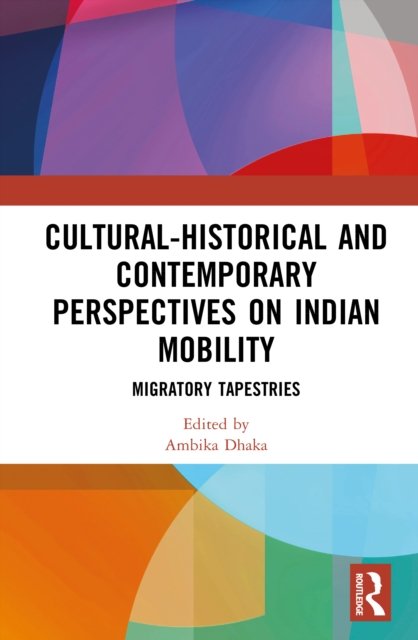
Cultural-Historical and Contemporary Perspectives on Indian Mobility
Redigert av Ambika Dhaka, 2026.
Migratory Tapestries
This book explores centuries of human movement across the Indian subcontinent through a groundbreaking interdisciplinary lens, masterfully weaving together anthropological insights, historical analysis, and personal narratives to create a multidimensional portrait of migration’s impact on society. It takes readers on an illuminating journey from medieval kingdoms to today’s digital diaspora, revealing the vibrant, complex stories behind human mobility through living case studies of medieval merchants establishing trade routes, colonial laborers forging new identities, and contemporary migrants navigating both physical and virtual borders. Going far beyond demographic statistics and transcending regional boundaries, this volume uncovers hidden perspectives of indigenous communities, examines migration through women’s experiences, and analyzes how legal frameworks have shaped human movement across generations, making it essential reading for researchers, policymakers, and anyone interested in understanding how migration functions not as a crisis to manage but as the fundamental rhythm of human civilization—beautifully illustrated through India’s diverse migration stories. This volume will be of interest to scholars and students of migration studies, South Asian history, cultural anthropology, human geography, diaspora studies, and post-colonial theory. It will also be an important read for policymakers engaged in migration governance, development practitioners, legal scholars specializing in mobility rights, and researchers examining the intersection of globalization and human movement.
Ikke tilgjengelig for Klikk&Hent
Forhåndsbestill
Forventes i salg 24.08.2026
Cultural-Historical and Contemporary Perspectives on Indian Mobility
Redigert av Ambika Dhaka, 2026.
Migratory Tapestries
This book explores centuries of human movement across the Indian subcontinent through a groundbreaking interdisciplinary lens, masterfully weaving together anthropological insights, historical analysis, and personal narratives to create a multidimensional portrait of migration’s impact on society. It takes readers on an illuminating journey from medieval kingdoms to today’s digital diaspora, revealing the vibrant, complex stories behind human mobility through living case studies of medieval merchants establishing trade routes, colonial laborers forging new identities, and contemporary migrants navigating both physical and virtual borders. Going far beyond demographic statistics and transcending regional boundaries, this volume uncovers hidden perspectives of indigenous communities, examines migration through women’s experiences, and analyzes how legal frameworks have shaped human movement across generations, making it essential reading for researchers, policymakers, and anyone interested in understanding how migration functions not as a crisis to manage but as the fundamental rhythm of human civilization—beautifully illustrated through India’s diverse migration stories. This volume will be of interest to scholars and students of migration studies, South Asian history, cultural anthropology, human geography, diaspora studies, and post-colonial theory. It will also be an important read for policymakers engaged in migration governance, development practitioners, legal scholars specializing in mobility rights, and researchers examining the intersection of globalization and human movement.
Ikke tilgjengelig for Klikk&Hent
Forhåndsbestill
Forventes i salg 24.08.2026
Ved å fullføre kjøpet aksepterer du kjøpsvilkårene.