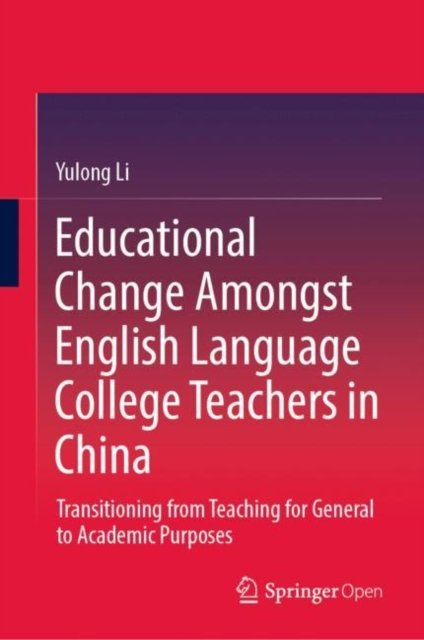
Educational Change Amongst English Language College Teachers in China
Av Yulong Li, 2020.
Transitioning from Teaching for General to Academic Purposes
Chapter 1 Introduction1. An EAP reform coming to China
Chapter 2: EAP and EAP teachers2.1 The concept of EAP2.2 Redefinition of EAP as multiple literacies2.2.1 Under traditionalism: language as a system and EAP as academic literacy2.2.2 Under progressivism: language as discourse and EAP as disciplinary cultural literacy2.2.3 Under criticalism: language as ideology and EAP as critical literacy2.2.4 Under digitalism: New meanings of language and EAP as digital literacy2.3 EAP Teacher development2.4 Research Rationales and research questions
Chapter 3: Research methodology3.1 Introduction3.2 Philosophical paradigms: Interpretivisim3.3 Methodology3.3.1 Ethnography3.3.2 Phenomenology3.3.3 Phenomenological ethnography3.4 Fieldwork methods3.4.1 Participant and non-participant observations3.4.2 Ethnographic and phenomenological interviews3.4.3 Researcher as tool: etic and emic3.4.4 Documentary analysis3.5 Positionality and reflexivity3.6 Plan for data analysis and organisation3.6.1 Thick description: the first layer of data3.6.2 Multiple Case studies: the second layer of data3.6.2.1 Life histories3.6.2.2 Discourse analysis and multimodal discourse analysis3.6.2.3 Thematic analysis3.6.3 Producing theories: the third layers of data3.7 Trustworthiness3.8 Generalisability3.9 Ethical concerns3.10 Summary
Chapter 4: Findings4.1 Introduction4.2 Thick description4.2.1 Field context4.2.2 Positionality of the author as a researcher entering the field: Summary of field notes4.3 Case Study 1: Fielding4.3.1 Life history of Fielding4.3.2 Getting to know Fielding4.3.2.1 Initially rejected but later accepted my invitation4.3.2.2 Did Fielding tell me what he really believes?4.3.2.3 Uncertain of what is EAP himself at the beginning4.3.2.4 He and his colleagues were not clear about EAP4.3.2.5 Designing an EAP course out of his own life experience and belief in education and language4.3.2.6 Fielding as a believer of learning by doing4.3.2.7 Fielding as a believer in language acquisition theory4.3.2.8 Teaching IELTS helps EAP4.3.2.9 Supporting learner autonomy as a reflection on Chinese students and their education contexts4.3.2.10 Understanding Chinese students4.3.2.11 How does Fielding understand EAP?4.3.2.12 What does Fielding think about the EAP Shanghai guideline?4.3.2.13 Teaching EAP concepts holistically4.3.2.14 Benefiting more from "self-trained" than sponsored EAP training4.3.2.15 EGP-EAP relation: Using different tasks for different purposes4.3.2.16 Nurturing ethical EAP learners: Do not become an "exquisite egoist"!4.3.2.17 Unveiling Fielding's smooth adaptation into EAP from EGP4.4 Case Study 2: Lisa4.4.1 Life history of Lisa4.4.2 From knowing to participation4.4.3 EAP is a logic and "disguised" language for doing research4.4.4 Lisa's perspective on the distinction between EAP and EGP and the Shanghai EAP reform4.4.5 Giving prescriptive discursive samples4.4.6 Inserted humanity into EAP teaching4.4.7 Empowering students and helping them make their voices heard4.4.8 Locating problems in EAP reform and teaching4.5 Case Study 3: Bluewitch4.5.1 Life history of Bluewitch
Ikke tilgjengelig for Klikk&Hent
Midlertidig tomt på lager
Bestillingsvare. Forventes sendt om ca 20 dager
Educational Change Amongst English Language College Teachers in China
Av Yulong Li, 2020.
Transitioning from Teaching for General to Academic Purposes
Chapter 1 Introduction1. An EAP reform coming to China
Chapter 2: EAP and EAP teachers2.1 The concept of EAP2.2 Redefinition of EAP as multiple literacies2.2.1 Under traditionalism: language as a system and EAP as academic literacy2.2.2 Under progressivism: language as discourse and EAP as disciplinary cultural literacy2.2.3 Under criticalism: language as ideology and EAP as critical literacy2.2.4 Under digitalism: New meanings of language and EAP as digital literacy2.3 EAP Teacher development2.4 Research Rationales and research questions
Chapter 3: Research methodology3.1 Introduction3.2 Philosophical paradigms: Interpretivisim3.3 Methodology3.3.1 Ethnography3.3.2 Phenomenology3.3.3 Phenomenological ethnography3.4 Fieldwork methods3.4.1 Participant and non-participant observations3.4.2 Ethnographic and phenomenological interviews3.4.3 Researcher as tool: etic and emic3.4.4 Documentary analysis3.5 Positionality and reflexivity3.6 Plan for data analysis and organisation3.6.1 Thick description: the first layer of data3.6.2 Multiple Case studies: the second layer of data3.6.2.1 Life histories3.6.2.2 Discourse analysis and multimodal discourse analysis3.6.2.3 Thematic analysis3.6.3 Producing theories: the third layers of data3.7 Trustworthiness3.8 Generalisability3.9 Ethical concerns3.10 Summary
Chapter 4: Findings4.1 Introduction4.2 Thick description4.2.1 Field context4.2.2 Positionality of the author as a researcher entering the field: Summary of field notes4.3 Case Study 1: Fielding4.3.1 Life history of Fielding4.3.2 Getting to know Fielding4.3.2.1 Initially rejected but later accepted my invitation4.3.2.2 Did Fielding tell me what he really believes?4.3.2.3 Uncertain of what is EAP himself at the beginning4.3.2.4 He and his colleagues were not clear about EAP4.3.2.5 Designing an EAP course out of his own life experience and belief in education and language4.3.2.6 Fielding as a believer of learning by doing4.3.2.7 Fielding as a believer in language acquisition theory4.3.2.8 Teaching IELTS helps EAP4.3.2.9 Supporting learner autonomy as a reflection on Chinese students and their education contexts4.3.2.10 Understanding Chinese students4.3.2.11 How does Fielding understand EAP?4.3.2.12 What does Fielding think about the EAP Shanghai guideline?4.3.2.13 Teaching EAP concepts holistically4.3.2.14 Benefiting more from "self-trained" than sponsored EAP training4.3.2.15 EGP-EAP relation: Using different tasks for different purposes4.3.2.16 Nurturing ethical EAP learners: Do not become an "exquisite egoist"!4.3.2.17 Unveiling Fielding's smooth adaptation into EAP from EGP4.4 Case Study 2: Lisa4.4.1 Life history of Lisa4.4.2 From knowing to participation4.4.3 EAP is a logic and "disguised" language for doing research4.4.4 Lisa's perspective on the distinction between EAP and EGP and the Shanghai EAP reform4.4.5 Giving prescriptive discursive samples4.4.6 Inserted humanity into EAP teaching4.4.7 Empowering students and helping them make their voices heard4.4.8 Locating problems in EAP reform and teaching4.5 Case Study 3: Bluewitch4.5.1 Life history of Bluewitch
Ikke tilgjengelig for Klikk&Hent
Midlertidig tomt på lager
Bestillingsvare. Forventes sendt om ca 20 dager
Ved å fullføre kjøpet aksepterer du kjøpsvilkårene.