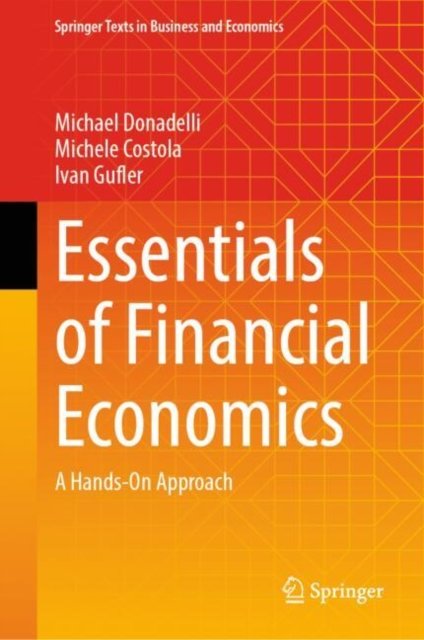
Essentials of Financial Economics
Av Ivan Gufler, Michele Costola, Michael Donadelli, 2025.Del av serien Springer Texts in Business and Economics.
A Hands-On Approach
This textbook offers a comprehensive guide to core topics in financial economics. It aims to provide both theoretical insights and practical applications in portfolio allocation, asset pricing, empirical finance, and behavioral finance. The primary goal is to equip students with a clear understanding of essential concepts through a mix of theory and empirical examples. The book focuses on key finance topics such as modern portfolio theory, asset pricing models, Black-Litterman asset allocation, empirical cross-sectional asset pricing, and event studies. Practical implementation is emphasized, utilizing programming languages like Matlab, Python, Julia, and R. Students are expected to have a foundational knowledge of calculus, linear algebra, statistics, and econometrics. The book starts with a brief review of key concepts related to decision-making under uncertainty and progresses to an exploration of intertemporal consumption choices and their impact on asset prices. In addition to bridging basic and advanced finance topics, the book aims to provide students with practical tools for navigating the financial landscape. Theoretical models are presented transparently, avoiding the "black box" issue by explaining mathematical derivations. This approach facilitates students' learning and enables them to use provided code across various programming languages for tasks like implementing mean-variance and Black-Litterman allocation, risk estimation, and market sentiment analysis.
Ikke tilgjengelig for Klikk&Hent
Midlertidig tomt på lager
Bestillingsvare. Forventes sendt om ca 20 dager
Essentials of Financial Economics
Av Ivan Gufler, Michele Costola, Michael Donadelli, 2025.Del av serien Springer Texts in Business and Economics.
A Hands-On Approach
This textbook offers a comprehensive guide to core topics in financial economics. It aims to provide both theoretical insights and practical applications in portfolio allocation, asset pricing, empirical finance, and behavioral finance. The primary goal is to equip students with a clear understanding of essential concepts through a mix of theory and empirical examples. The book focuses on key finance topics such as modern portfolio theory, asset pricing models, Black-Litterman asset allocation, empirical cross-sectional asset pricing, and event studies. Practical implementation is emphasized, utilizing programming languages like Matlab, Python, Julia, and R. Students are expected to have a foundational knowledge of calculus, linear algebra, statistics, and econometrics. The book starts with a brief review of key concepts related to decision-making under uncertainty and progresses to an exploration of intertemporal consumption choices and their impact on asset prices. In addition to bridging basic and advanced finance topics, the book aims to provide students with practical tools for navigating the financial landscape. Theoretical models are presented transparently, avoiding the "black box" issue by explaining mathematical derivations. This approach facilitates students' learning and enables them to use provided code across various programming languages for tasks like implementing mean-variance and Black-Litterman allocation, risk estimation, and market sentiment analysis.
Ikke tilgjengelig for Klikk&Hent
Midlertidig tomt på lager
Bestillingsvare. Forventes sendt om ca 20 dager
Ved å fullføre kjøpet aksepterer du kjøpsvilkårene.