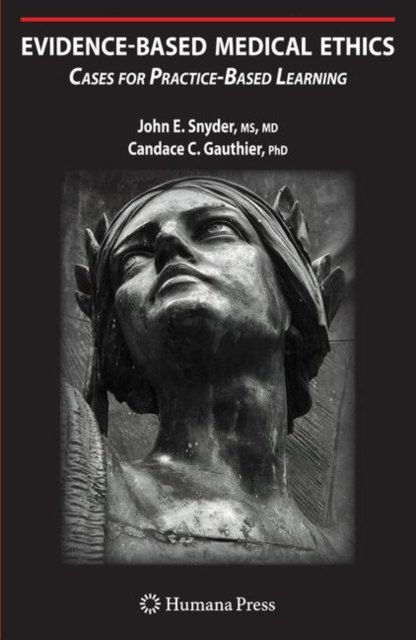
Evidence-Based Medical Ethics
Av Candace C. Gauthier, John E. Snyder, 2010.
Cases for Practice-Based Learning
Case-Based Medical Ethics in Practice
Preface by the authors
Foreword
Chapter 1: A brief introduction to medical ethics in Internal Medicine
- Definitions of ethics and medical ethics
- Why is medical ethics important? (teaching competency in ethics, teaching professionalism)
- Evolution of medical ethics and its importance/role in modern medicine (from paternalism to informed consent)
- Who determines ethical guidelines for medicine?
- Difference/similarities between ethics and law
- Purpose of the book (i.e. to stimulate thought and discussion, not cover all details of all ethical principles)
Chapter 2: The underlying principles of ethical patient care
- Beneficence - a practitioner should act in the best interest of the patient. (Salus aegroti suprema lex.)
- Non-maleficence - "first, do no harm" (Primum non nocere).
- Autonomy - the patient has the right to refuse or choose their treatment (Voluntas aegroti suprema lex.)
- Justice - concerns the distribution of scarce health resources, and the decision of who gets what treatment.
- Dignity - the patient (and the person treating the patient) have the right to dignity.
- Veracity - the patient should not be lied to, and deserves to know the whole truth about his/her illness and treatment.
Chapter 3: Putting ethics into practice - realities, limitations, and roadblocks
- Practitioners and personal belief systems
- Cultural competency and practice of ethical care
- Statement about pharmaceutical company influence on education and practice
- Medical oaths - Are they valid for medicine today? Are they fulfilled by practitioners?
- The Patient Bill of Rights
- Federal, state, local, and institutional regulations - how they intertwine and affect each other
Chapter 4: Advanced Directives, Living Wills, and the Health Care Power of Attorney (HCPOA)
Chapter 5: Case-based ethical dilemmas
- How the reader should approach these cases
- Where to find more information if needed
Case 1
- Topic: Consent in the mentally ill or otherwise unfit (and 'in between' situations: delirium, psychiatric decompensation)
- Subtopic: When does forcing an incompetent patient to undergo treatment limit their right to dignity and the principle of 'do-no-harm'?
• Narrative of clinical scenario with specific example of ethical dilemma
• Questions for thought/discussion
• Explanations of underlying ethical and legal principles
Case 2
- Topic: When the HCPOA neglects their responsibility, or has other personal interests/potential gains
• Narrative of clinical scenario with specific example of ethical dilemma
• Questions for thought/discussion
• Explanations of underlying ethical and legal principles
Case 3
- Topic: When the patient/their family bullies practitioners into unnecessary diagnostics/therapeutics
- "C.Y.A." medicine
• Narrative of clinical scenario with specific example of ethical dilemma
• Questions for thought/discussion
• Explanations of underlying ethical and legal principles
Case 4
- Topic: When an estranged family member or spouse suddenly appears to make decisions
• Narrative of c
Ikke tilgjengelig for Klikk&Hent
Midlertidig tomt på lager
Bestillingsvare. Forventes sendt om ca 20 dager
Oppdag mer
Evidence-Based Medical Ethics
Av Candace C. Gauthier, John E. Snyder, 2010.
Cases for Practice-Based Learning
Case-Based Medical Ethics in Practice
Preface by the authors
Foreword
Chapter 1: A brief introduction to medical ethics in Internal Medicine
- Definitions of ethics and medical ethics
- Why is medical ethics important? (teaching competency in ethics, teaching professionalism)
- Evolution of medical ethics and its importance/role in modern medicine (from paternalism to informed consent)
- Who determines ethical guidelines for medicine?
- Difference/similarities between ethics and law
- Purpose of the book (i.e. to stimulate thought and discussion, not cover all details of all ethical principles)
Chapter 2: The underlying principles of ethical patient care
- Beneficence - a practitioner should act in the best interest of the patient. (Salus aegroti suprema lex.)
- Non-maleficence - "first, do no harm" (Primum non nocere).
- Autonomy - the patient has the right to refuse or choose their treatment (Voluntas aegroti suprema lex.)
- Justice - concerns the distribution of scarce health resources, and the decision of who gets what treatment.
- Dignity - the patient (and the person treating the patient) have the right to dignity.
- Veracity - the patient should not be lied to, and deserves to know the whole truth about his/her illness and treatment.
Chapter 3: Putting ethics into practice - realities, limitations, and roadblocks
- Practitioners and personal belief systems
- Cultural competency and practice of ethical care
- Statement about pharmaceutical company influence on education and practice
- Medical oaths - Are they valid for medicine today? Are they fulfilled by practitioners?
- The Patient Bill of Rights
- Federal, state, local, and institutional regulations - how they intertwine and affect each other
Chapter 4: Advanced Directives, Living Wills, and the Health Care Power of Attorney (HCPOA)
Chapter 5: Case-based ethical dilemmas
- How the reader should approach these cases
- Where to find more information if needed
Case 1
- Topic: Consent in the mentally ill or otherwise unfit (and 'in between' situations: delirium, psychiatric decompensation)
- Subtopic: When does forcing an incompetent patient to undergo treatment limit their right to dignity and the principle of 'do-no-harm'?
• Narrative of clinical scenario with specific example of ethical dilemma
• Questions for thought/discussion
• Explanations of underlying ethical and legal principles
Case 2
- Topic: When the HCPOA neglects their responsibility, or has other personal interests/potential gains
• Narrative of clinical scenario with specific example of ethical dilemma
• Questions for thought/discussion
• Explanations of underlying ethical and legal principles
Case 3
- Topic: When the patient/their family bullies practitioners into unnecessary diagnostics/therapeutics
- "C.Y.A." medicine
• Narrative of clinical scenario with specific example of ethical dilemma
• Questions for thought/discussion
• Explanations of underlying ethical and legal principles
Case 4
- Topic: When an estranged family member or spouse suddenly appears to make decisions
• Narrative of c
Oppdag mer
Ikke tilgjengelig for Klikk&Hent
Midlertidig tomt på lager
Bestillingsvare. Forventes sendt om ca 20 dager
Ved å fullføre kjøpet aksepterer du kjøpsvilkårene.