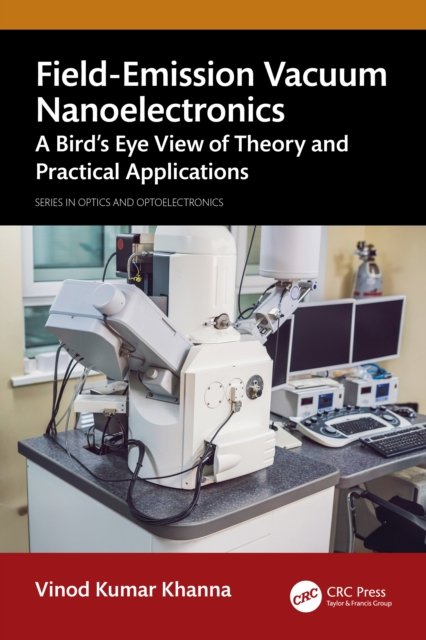
Field-Emission Vacuum Nanoelectronics
Av Vinod Khanna, 2026.Del av serien Series in Optics and Optoelectronics.
A Bird’s Eye View of Theory and Practical Applications
Field-Emission Vacuum Nanoelectronics: A Bird’s Eye View of Theory and Practical Applications explores the field in both theoretical and practical perspectives. Field-emission devices have moved from specialized applications to become potential candidates for a future beyond-complementary metal-oxide-semiconductor (CMOS) circuits, offering superior performance at extreme temperatures, in harsh environments, and at high frequencies, due to their reliance on ballistic transport in vacuum-like or nanogap air-filled environments rather than solid-state lattice transport. Beginning with the mechanisms of electron emission from materials and highlighting the role of nanotechnology in field emission, the Fowler–Nordheim theory of field emission is extensively treated. Enhancements of the Fowler–Nordheim theory and its various alternatives are addressed, with emphasis on the Schottky–Nordheim transmission barrier, the Murphy–Good theory, and efforts made to rephrase and reformulate the standard Fowler–Nordheim theory. On the practical side, the key components of field-emission devices, namely, cold cathodes, arrays, and electron guns, are described. Applications covered include field-emission displays and lamps, diodes and transistors, microwave power tubes (magnetrons, gyrotrons, klystrons, and traveling-wave tubes [TWTs]), information storage devices, sensors, electron microscopy, spectroscopy, scanning probe lithography, X-ray tubes, electric propulsion thrusters, and charge neutralizers. This book concludes with a discussion of research challenges and the future outlook for field-emission nanoelectronics. This book will be immensely useful to graduate and research students, engineers, and scientists. Key features:Provides a simplified and up-to-date treatment of the theory and technological applications of field emission in nanoelectronicsShowcases each field-emission application by unveiling its operation, unique benefits, fabrication process, key milestones, and emerging research directionsBrings the underlying mathematical concepts to life with abundant, easy-to-follow examples
Ikke tilgjengelig for Klikk&Hent
Forhåndsbestill
Forventes i salg 08.09.2026
Field-Emission Vacuum Nanoelectronics
Av Vinod Khanna, 2026.Del av serien Series in Optics and Optoelectronics.
A Bird’s Eye View of Theory and Practical Applications
Field-Emission Vacuum Nanoelectronics: A Bird’s Eye View of Theory and Practical Applications explores the field in both theoretical and practical perspectives. Field-emission devices have moved from specialized applications to become potential candidates for a future beyond-complementary metal-oxide-semiconductor (CMOS) circuits, offering superior performance at extreme temperatures, in harsh environments, and at high frequencies, due to their reliance on ballistic transport in vacuum-like or nanogap air-filled environments rather than solid-state lattice transport. Beginning with the mechanisms of electron emission from materials and highlighting the role of nanotechnology in field emission, the Fowler–Nordheim theory of field emission is extensively treated. Enhancements of the Fowler–Nordheim theory and its various alternatives are addressed, with emphasis on the Schottky–Nordheim transmission barrier, the Murphy–Good theory, and efforts made to rephrase and reformulate the standard Fowler–Nordheim theory. On the practical side, the key components of field-emission devices, namely, cold cathodes, arrays, and electron guns, are described. Applications covered include field-emission displays and lamps, diodes and transistors, microwave power tubes (magnetrons, gyrotrons, klystrons, and traveling-wave tubes [TWTs]), information storage devices, sensors, electron microscopy, spectroscopy, scanning probe lithography, X-ray tubes, electric propulsion thrusters, and charge neutralizers. This book concludes with a discussion of research challenges and the future outlook for field-emission nanoelectronics. This book will be immensely useful to graduate and research students, engineers, and scientists. Key features:Provides a simplified and up-to-date treatment of the theory and technological applications of field emission in nanoelectronicsShowcases each field-emission application by unveiling its operation, unique benefits, fabrication process, key milestones, and emerging research directionsBrings the underlying mathematical concepts to life with abundant, easy-to-follow examples
Ikke tilgjengelig for Klikk&Hent
Forhåndsbestill
Forventes i salg 08.09.2026
Ved å fullføre kjøpet aksepterer du kjøpsvilkårene.