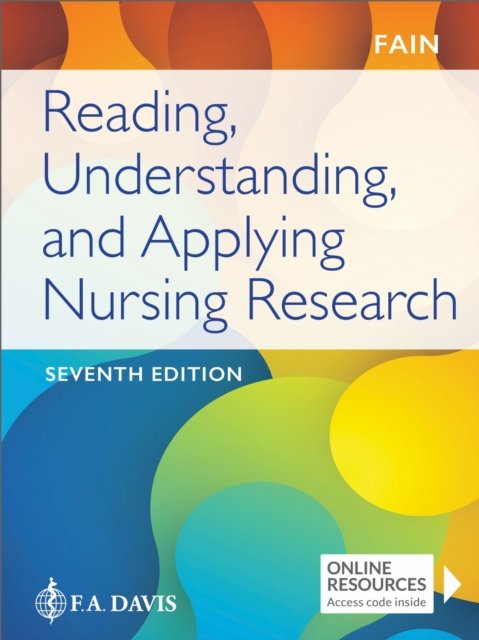
Reading, Understanding, and Applying Nursing Research
Av James A. Fain, 2024.
What is the evidence?How do you find it?How do you evaluate it? Put the evidence to work in practice! Integrate today’s best scientific knowledge into students’ clinical decision-making. Step by step, they’ll learn to effectively evaluate and apply nursing research and to understand its potential impact on the quality of their patient care. Five Stars! Easy to read. “Great book, easy to read, very good review of research for beginners, lots of information but goes over a lot, definitely a keeper!”—Online Reviewer Five Stars!! Good Textbook. “Reading this for my NUR 261 Research course. Gets to the point in terms of content and is relatively easy to read.”—Samuel, Online Reviewer Five Stars!! Very useful. “Love it.”—Online Reviewer New! Increased coverage of evidence-based practice in each chapterNew! Focus on recognizing the cues of the Clinical Judgment Measurement Model and preparing for the Next Gen NCLEX®New! Rapid “Critical Appraisal Checklists” in the chapter on evidence-based practiceNew! Emphasis on qualitative research designsNew! Examples of the PICOT model throughout the textUpdated! Standards for Quality Improvement Reporting Excellence (SQUIRE 2.0) guidelinesExpanded! Content on qualitative and mixed-methods research designsDiscusses the importance of nursing research as the foundation for best practices (evidence-based nursing) and the different types of nursing scholarship, including research, quality improvement, and evidence-based initiatives. Covers all the steps of the research process, addressing inductive and deductive reasoning and forming research questions and hypotheses from a conceptual model or theoretical framework. Addresses how to select a quantitative or qualitative design based on the research question as well as the principles of each type of design and its sampling, data collection, issues of measurement, and data analyses. Introduces strategies for evaluating and critiquing research reports along with guidelines for using research findings. Provides easy-to-follow guidelines for reading and critically appraising aspects of the research process in a published study. Offers tools to make learning easier, including “Learning Objectives,” “Glossaries of Key Terms,” “Excerpts from Existing Research Report,” “Critiquing Aspects of a Research Report,” “Web Links,” “Summary of Key Ideas,” and “Learning Activities”.
Ikke tilgjengelig for Klikk&Hent
Midlertidig tomt på lager
Bestillingsvare. Forventes sendt om ca 10 dager
Oppdag mer
Reading, Understanding, and Applying Nursing Research
Av James A. Fain, 2024.
What is the evidence?How do you find it?How do you evaluate it? Put the evidence to work in practice! Integrate today’s best scientific knowledge into students’ clinical decision-making. Step by step, they’ll learn to effectively evaluate and apply nursing research and to understand its potential impact on the quality of their patient care. Five Stars! Easy to read. “Great book, easy to read, very good review of research for beginners, lots of information but goes over a lot, definitely a keeper!”—Online Reviewer Five Stars!! Good Textbook. “Reading this for my NUR 261 Research course. Gets to the point in terms of content and is relatively easy to read.”—Samuel, Online Reviewer Five Stars!! Very useful. “Love it.”—Online Reviewer New! Increased coverage of evidence-based practice in each chapterNew! Focus on recognizing the cues of the Clinical Judgment Measurement Model and preparing for the Next Gen NCLEX®New! Rapid “Critical Appraisal Checklists” in the chapter on evidence-based practiceNew! Emphasis on qualitative research designsNew! Examples of the PICOT model throughout the textUpdated! Standards for Quality Improvement Reporting Excellence (SQUIRE 2.0) guidelinesExpanded! Content on qualitative and mixed-methods research designsDiscusses the importance of nursing research as the foundation for best practices (evidence-based nursing) and the different types of nursing scholarship, including research, quality improvement, and evidence-based initiatives. Covers all the steps of the research process, addressing inductive and deductive reasoning and forming research questions and hypotheses from a conceptual model or theoretical framework. Addresses how to select a quantitative or qualitative design based on the research question as well as the principles of each type of design and its sampling, data collection, issues of measurement, and data analyses. Introduces strategies for evaluating and critiquing research reports along with guidelines for using research findings. Provides easy-to-follow guidelines for reading and critically appraising aspects of the research process in a published study. Offers tools to make learning easier, including “Learning Objectives,” “Glossaries of Key Terms,” “Excerpts from Existing Research Report,” “Critiquing Aspects of a Research Report,” “Web Links,” “Summary of Key Ideas,” and “Learning Activities”.
Oppdag mer
Ikke tilgjengelig for Klikk&Hent
Midlertidig tomt på lager
Bestillingsvare. Forventes sendt om ca 10 dager
Ved å fullføre kjøpet aksepterer du kjøpsvilkårene.