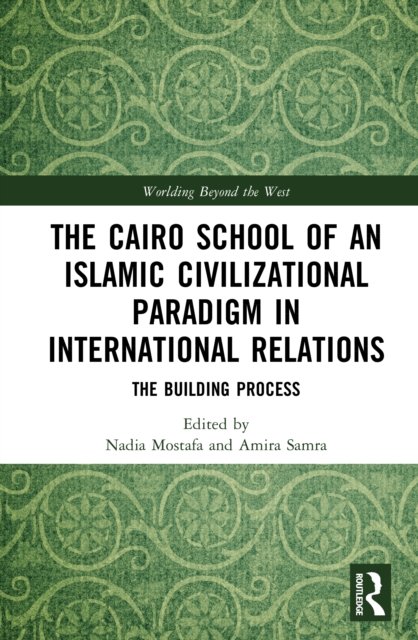
The Cairo School of an Islamic Civilizational Paradigm in International Relations
Redigert av Amira Samra, Nadia Mostafa, 2026.Del av serien Worlding Beyond the West.
The Building Process
The Cairo School of an Islamic Civilizational Paradigm in International Relations: The Building Process traces the intellectual evolution of a multi-generational scholarly project developed at Cairo University’s Faculty of Economics and Political Science over four decades. Rather than treating Islam as a cultural or political variable, the paradigm positions Islam as a standpoint shaping knowledge production in the discipline. It introduces a taw?idi (monotheism-based) epistemic framework that rethinks the claimed universality of International Relations’ metatheoretical foundations while recognizing plural worldviews and their formative role in theory, methodology, and ontology. Moving beyond traditional jurisprudential approaches, the paradigm advances a multidimensional civilizational approach to IR that integrates historical, ethical, cultural, and social dimensions into the analysis of global politics. The book explores the paradigm’s origins, core assumptions, conceptual architecture, and cumulative development across generations. It situates the approach primarily in relation to positivist and post-positivist traditions while also engaging non-Western approaches and emphasizes its comparative method of theorization and concept formation. Arguing for a more inclusive and epistemologically diverse understanding of global politics The Cairo School of an Islamic Civilizational Paradigm in International Relations will appeal to advanced students and scholars of international relations, catering to those with an inclusive and epistemologically diverse understanding of global politics.
Ikke tilgjengelig for Klikk&Hent
Forhåndsbestill
Forventes i salg 27.07.2026
The Cairo School of an Islamic Civilizational Paradigm in International Relations
Redigert av Amira Samra, Nadia Mostafa, 2026.Del av serien Worlding Beyond the West.
The Building Process
The Cairo School of an Islamic Civilizational Paradigm in International Relations: The Building Process traces the intellectual evolution of a multi-generational scholarly project developed at Cairo University’s Faculty of Economics and Political Science over four decades. Rather than treating Islam as a cultural or political variable, the paradigm positions Islam as a standpoint shaping knowledge production in the discipline. It introduces a taw?idi (monotheism-based) epistemic framework that rethinks the claimed universality of International Relations’ metatheoretical foundations while recognizing plural worldviews and their formative role in theory, methodology, and ontology. Moving beyond traditional jurisprudential approaches, the paradigm advances a multidimensional civilizational approach to IR that integrates historical, ethical, cultural, and social dimensions into the analysis of global politics. The book explores the paradigm’s origins, core assumptions, conceptual architecture, and cumulative development across generations. It situates the approach primarily in relation to positivist and post-positivist traditions while also engaging non-Western approaches and emphasizes its comparative method of theorization and concept formation. Arguing for a more inclusive and epistemologically diverse understanding of global politics The Cairo School of an Islamic Civilizational Paradigm in International Relations will appeal to advanced students and scholars of international relations, catering to those with an inclusive and epistemologically diverse understanding of global politics.
Ikke tilgjengelig for Klikk&Hent
Forhåndsbestill
Forventes i salg 27.07.2026
Ved å fullføre kjøpet aksepterer du kjøpsvilkårene.
Populært i samme kategori
Time, Memory, and the Politics of Contingency
Time, Memory, and the Politics of Contingency
The Routledge Handbook of Religion and Politics in Europe
Religion and Political Change in the Modern World
Islam, IS and the Fragmented State

Spatiotemporal Politics in Contemporary Iran
Islam, State, and Modernity
Flere bøker i serien
Theory as Ideology in International Relations
Making Global Knowledge in Local Contexts
NGOs, Knowledge Production and Global Humanist Advocacy
Naming a Transnational Black Feminist Framework
Internal Colonialism and International Relations
Decolonization, Development and Knowledge in Africa
Marxism and Decolonization in the 21st Century