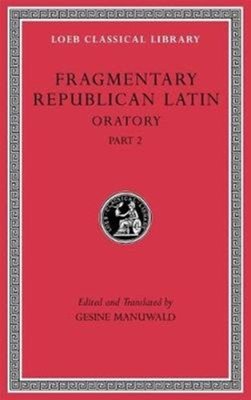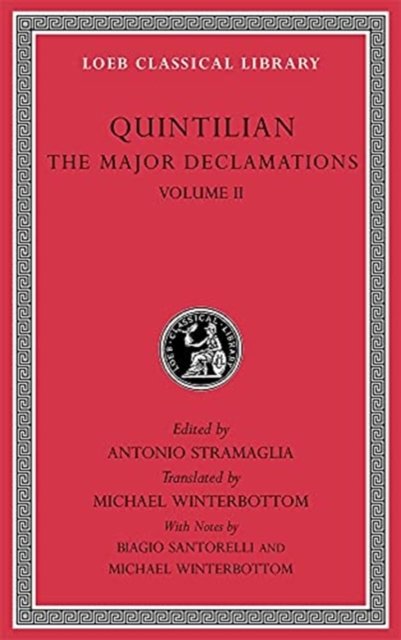
The Major Declamations, Volume II
Av Quintilian, Antonio Stramaglia (red.), 2021.Del av serien Loeb Classical Library.
Mock trial—Roman style. The Major Declamations stand out for their unique contribution to our understanding of the final stage in Greco-Roman rhetorical training. These exercises, in which students learned how to compose and deliver speeches on behalf of either the prosecution or the defense at imaginary trials, demonstrate how standard themes, recurring situations and arguments, and technical rules were to be handled by the aspiring orator. And what is more, they lay bare the mistakes that students often made in this process. Declamation was practiced in the ancient world from as early as the fifth century BC, but most of its vast tradition has disappeared. The surviving material is mainly in Greek, from the second century AD onward. In Latin the nineteen declamations in the present anthology are by far the most important evidence. In antiquity they were attributed to Quintilian, but they are now thought to be the work of several authors and to date from around AD 100 to the mid- or late third century. A wide variety of fascinating ethical, social, and legal details animates the fictional world conjured up by these oratorical exercises, and although the themes of declamation can be unrealistic and even absurd (often reminiscent of ancient novel and tragedy), they seem to provide a safe space in which a student could confront a range of complex issues, so as to attain both the technical knowledge necessary to speak persuasively and the soft skills needed to manage the challenges of adult life under the Roman empire.
Ved å fullføre kjøpet aksepterer jeg kjøpsvilkårene.
Ikke tilgjengelig for Klikk&Hent
På nettlager. Bestilles fra England. Leveres normalt innen 5-8 virkedager.
The Major Declamations, Volume II
Av Quintilian, Antonio Stramaglia (red.), 2021.Del av serien Loeb Classical Library.
Mock trial—Roman style. The Major Declamations stand out for their unique contribution to our understanding of the final stage in Greco-Roman rhetorical training. These exercises, in which students learned how to compose and deliver speeches on behalf of either the prosecution or the defense at imaginary trials, demonstrate how standard themes, recurring situations and arguments, and technical rules were to be handled by the aspiring orator. And what is more, they lay bare the mistakes that students often made in this process. Declamation was practiced in the ancient world from as early as the fifth century BC, but most of its vast tradition has disappeared. The surviving material is mainly in Greek, from the second century AD onward. In Latin the nineteen declamations in the present anthology are by far the most important evidence. In antiquity they were attributed to Quintilian, but they are now thought to be the work of several authors and to date from around AD 100 to the mid- or late third century. A wide variety of fascinating ethical, social, and legal details animates the fictional world conjured up by these oratorical exercises, and although the themes of declamation can be unrealistic and even absurd (often reminiscent of ancient novel and tragedy), they seem to provide a safe space in which a student could confront a range of complex issues, so as to attain both the technical knowledge necessary to speak persuasively and the soft skills needed to manage the challenges of adult life under the Roman empire.
Ved å fullføre kjøpet aksepterer jeg kjøpsvilkårene.
Ikke tilgjengelig for Klikk&Hent
På nettlager. Bestilles fra England. Leveres normalt innen 5-8 virkedager.
Ved å fullføre kjøpet aksepterer du kjøpsvilkårene.