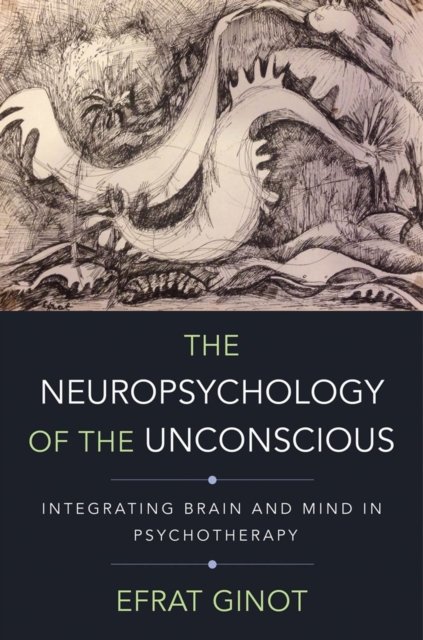
The Neuropsychology of the Unconscious
Av Efrat Ginot, 2015.Del av serien Norton Series on Interpersonal Neurobiology.
Integrating Brain and Mind in Psychotherapy
More than one hundred years after Freud began publishing some of his seminal theories, the concept of the unconscious still occupies a central position in many theoretical frameworks and clinical approaches. When trying to understand clients’ internal and interpersonal struggles it is almost inconceivable not to look for unconscious motivation, conflicts and relational patterns. Clinicians also consider it a breakthrough to recognise how our own unconscious patterns have interacted with those of our clients. Although clinicians use concepts such as the unconscious and dissociation, in actuality many do not take into account the newly emerging neuropsychological attributes of nonconscious processes. As a result, assumptions and lack of clarity overtake information that can become central in our clinical work. This revolutionary book presents a new model of the unconscious, one that is continuing to emerge from the integration of neuropsychological research with clinical experience. Topics covered include:The centrality of subcortical regionsAutomaticity, repetition, and biased memory systemsRole of the amygdala and its sensitivity to fears in shaping and coloring unconscious self-systemsSelf-narrativesTherapeutic enactmentsTherapeutic resistanceDefensive systems and narcissismTherapeutic approaches designed to utilize some of the new understandings regarding unconscious processes and their interaction with higher-level conscious ones embedded in the prefrontal cortex
Ikke tilgjengelig for Klikk&Hent
Midlertidig tomt på lager
Bestillingsvare. Forventes sendt om ca 14 dager
The Neuropsychology of the Unconscious
Av Efrat Ginot, 2015.Del av serien Norton Series on Interpersonal Neurobiology.
Integrating Brain and Mind in Psychotherapy
More than one hundred years after Freud began publishing some of his seminal theories, the concept of the unconscious still occupies a central position in many theoretical frameworks and clinical approaches. When trying to understand clients’ internal and interpersonal struggles it is almost inconceivable not to look for unconscious motivation, conflicts and relational patterns. Clinicians also consider it a breakthrough to recognise how our own unconscious patterns have interacted with those of our clients. Although clinicians use concepts such as the unconscious and dissociation, in actuality many do not take into account the newly emerging neuropsychological attributes of nonconscious processes. As a result, assumptions and lack of clarity overtake information that can become central in our clinical work. This revolutionary book presents a new model of the unconscious, one that is continuing to emerge from the integration of neuropsychological research with clinical experience. Topics covered include:The centrality of subcortical regionsAutomaticity, repetition, and biased memory systemsRole of the amygdala and its sensitivity to fears in shaping and coloring unconscious self-systemsSelf-narrativesTherapeutic enactmentsTherapeutic resistanceDefensive systems and narcissismTherapeutic approaches designed to utilize some of the new understandings regarding unconscious processes and their interaction with higher-level conscious ones embedded in the prefrontal cortex
Ikke tilgjengelig for Klikk&Hent
Midlertidig tomt på lager
Bestillingsvare. Forventes sendt om ca 14 dager
Ved å fullføre kjøpet aksepterer du kjøpsvilkårene.