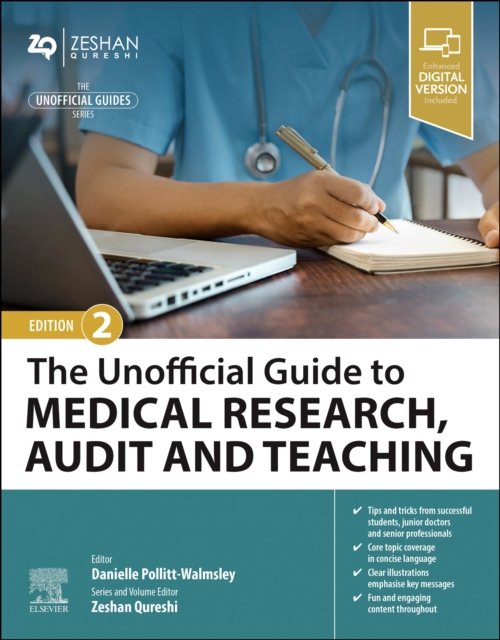
The Unofficial Guide to Medical Research, Audit and Teaching
Redigert av Danielle Pollitt-Walmsley, Zeshan, BM,BSc,MSc,BM MRCPCH,FAcadMEd,MRCPS(Glasg) (History and Philosophy of Science, University o, 2026.
The unique and award-winning Unofficial Guides series is a collaboration between senior students, junior doctors and specialty experts. This combination of contributors understands what is essential to excel on your course, in exams and in practice - as well as the importance of presenting information in a clear, fun and engaging way. Packed with hints and tips from those in the know, when you are in a hurry and need a study companion you can trust, reach for an Unofficial Guide.
This unique book provides a succinct introduction to how to pursue research, teaching or audit opportunities. You’ll find guidance on how to do a literature search, key concepts in statistics, and tips for science communication, critical appraisal and clinical governance - all written in a concise way that’s perfect for undergraduates.
Fully updated for its second edition, the Unofficial Guide to Medical Research, Audit and Teaching will be a day-to-day reference you use long after you’ve graduated.
- Step by step guide covering everything you need to know to undertake research, audit or teaching - easily accessible and all in one place
- Clearly laid out and easy to understand
- Practical tips and tricks - covers not just what you need to do, but also how to do it
- Includes a concise guide to medical statistics
- Convenient checklists for analysing the different types of research studies
- Guidance on finding research opportunities and how to approach a supervisor
- Tips for effective teaching
- Guidance for portfolios
- Updated information regarding specialised foundation programme
- Advice on working abroad - including Australia and New Zealand
- Information regarding hierarchy of evidence and n=1 studies
- Updated examples to explain statistical analysis techniques
- Introduction to clinical commissioning and policy development
- Use of social media and online communities for science communication
- Digital teaching
- New and emerging research areas including computational modelling
Ved å fullføre kjøpet aksepterer jeg kjøpsvilkårene.
Ikke tilgjengelig for Klikk&Hent
På nettlager. Bestilles fra England. Leveres normalt innen 5-8 virkedager.
The Unofficial Guide to Medical Research, Audit and Teaching
Redigert av Danielle Pollitt-Walmsley, Zeshan, BM,BSc,MSc,BM MRCPCH,FAcadMEd,MRCPS(Glasg) (History and Philosophy of Science, University o, 2026.
The unique and award-winning Unofficial Guides series is a collaboration between senior students, junior doctors and specialty experts. This combination of contributors understands what is essential to excel on your course, in exams and in practice - as well as the importance of presenting information in a clear, fun and engaging way. Packed with hints and tips from those in the know, when you are in a hurry and need a study companion you can trust, reach for an Unofficial Guide.
This unique book provides a succinct introduction to how to pursue research, teaching or audit opportunities. You’ll find guidance on how to do a literature search, key concepts in statistics, and tips for science communication, critical appraisal and clinical governance - all written in a concise way that’s perfect for undergraduates.
Fully updated for its second edition, the Unofficial Guide to Medical Research, Audit and Teaching will be a day-to-day reference you use long after you’ve graduated.
- Step by step guide covering everything you need to know to undertake research, audit or teaching - easily accessible and all in one place
- Clearly laid out and easy to understand
- Practical tips and tricks - covers not just what you need to do, but also how to do it
- Includes a concise guide to medical statistics
- Convenient checklists for analysing the different types of research studies
- Guidance on finding research opportunities and how to approach a supervisor
- Tips for effective teaching
- Guidance for portfolios
- Updated information regarding specialised foundation programme
- Advice on working abroad - including Australia and New Zealand
- Information regarding hierarchy of evidence and n=1 studies
- Updated examples to explain statistical analysis techniques
- Introduction to clinical commissioning and policy development
- Use of social media and online communities for science communication
- Digital teaching
- New and emerging research areas including computational modelling
Ved å fullføre kjøpet aksepterer jeg kjøpsvilkårene.
Ikke tilgjengelig for Klikk&Hent
På nettlager. Bestilles fra England. Leveres normalt innen 5-8 virkedager.
Ved å fullføre kjøpet aksepterer du kjøpsvilkårene.