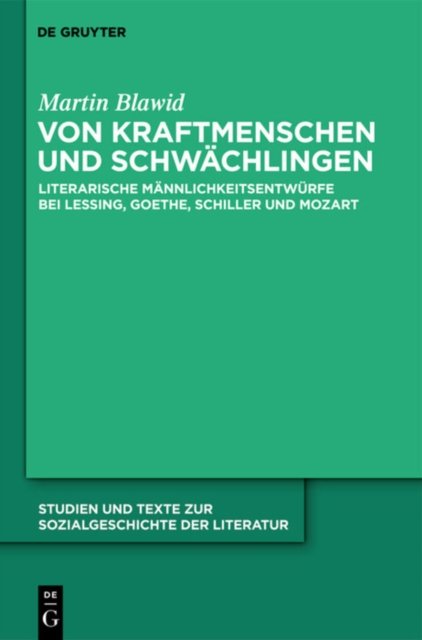
Von Kraftmenschen und Schwächlingen
Av Martin Blawid, 2011.Del av serien Studien Und Texte Zur Sozialgeschichte der Literatur.
Die Arbeit widmet sich der Untersuchung literarischer Männlichkeitsentwürfe in deutschen und italienischen Dramentexten des späten 18. Jahrhunderts. Auf der Grundlage einer historisch-epistemologischen Begriffsdefinition von ‚Männlichkeit‘ sowie aktueller Theorieansätze der ‚Männerforschung‘ im 20. und 21. Jahrhundert werden folgende Textbeispiele analysiert: Gotthold Ephraim Lessings Minna von Barnhelm oder das Soldatenglück, Johann Wolfgang Goethes Götz von Berlichingen mit der eisernen Hand, Friedrich Schillers Die Räuber sowie Wolfgang Amadeus Mozarts / Lorenzo Da Pontes Le Nozze di Figaro, Don Giovanni ossia il Dissoluto Punito und Così fan tutte o sia La scuola degli amanti.
Dabei erweisen sich die männlichen Figuren der ausgewählten Textbeispiele als vielseitiger, mehrdimensionaler Untersuchungsgegenstand im Spannungsfeld zwischen tradierten Rollenmustern einer imaginierten zeitgenössischen Form von ‚Männlichkeit‘ im 18. Jahrhundert und deren zunehmender Infragestellung in den Dramentexten. Ein besonderes Augenmerk wird in diesem Zusammenhang auf das Streben nach einer ‚hegemonialen‘ Form von ‚Männlichkeit‘ gelegt, wie sie von der australischen Soziologin Raewyn Connell beschrieben wird.
Ikke tilgjengelig for Klikk&Hent
Midlertidig tomt på lager
Bestillingsvare. Forventes sendt om ca 14 dager
Von Kraftmenschen und Schwächlingen
Av Martin Blawid, 2011.Del av serien Studien Und Texte Zur Sozialgeschichte der Literatur.
Die Arbeit widmet sich der Untersuchung literarischer Männlichkeitsentwürfe in deutschen und italienischen Dramentexten des späten 18. Jahrhunderts. Auf der Grundlage einer historisch-epistemologischen Begriffsdefinition von ‚Männlichkeit‘ sowie aktueller Theorieansätze der ‚Männerforschung‘ im 20. und 21. Jahrhundert werden folgende Textbeispiele analysiert: Gotthold Ephraim Lessings Minna von Barnhelm oder das Soldatenglück, Johann Wolfgang Goethes Götz von Berlichingen mit der eisernen Hand, Friedrich Schillers Die Räuber sowie Wolfgang Amadeus Mozarts / Lorenzo Da Pontes Le Nozze di Figaro, Don Giovanni ossia il Dissoluto Punito und Così fan tutte o sia La scuola degli amanti.
Dabei erweisen sich die männlichen Figuren der ausgewählten Textbeispiele als vielseitiger, mehrdimensionaler Untersuchungsgegenstand im Spannungsfeld zwischen tradierten Rollenmustern einer imaginierten zeitgenössischen Form von ‚Männlichkeit‘ im 18. Jahrhundert und deren zunehmender Infragestellung in den Dramentexten. Ein besonderes Augenmerk wird in diesem Zusammenhang auf das Streben nach einer ‚hegemonialen‘ Form von ‚Männlichkeit‘ gelegt, wie sie von der australischen Soziologin Raewyn Connell beschrieben wird.
Ikke tilgjengelig for Klikk&Hent
Midlertidig tomt på lager
Bestillingsvare. Forventes sendt om ca 14 dager
Ved å fullføre kjøpet aksepterer du kjøpsvilkårene.