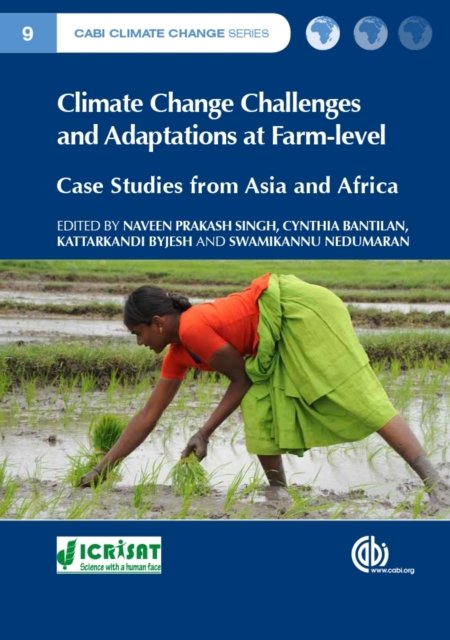
Climate Change Challenges and Adaptations at Farm-level
Redigert av Cynthia , ICRISAT, India) Bantilan, Swamikannu , ICRISAT, India) Nedumaran, Naveen P , ICRISAT, India) Singh, Kattarkandi Byjesh, 2015.Del av serien CABI Climate Change Series.
Case Studies from Asia and Africa
This book emphasis the role of farm level adaptation as a key in developmental pathways that are challenged by climate risks in the semi-arid tropics of Asia and Africa. It throws light on key issues that arise in farm level impacts, adaptation and vulnerability to climate change and discusses Q2 methodological approaches undertaken in study domains of Asia and Africa. The book systematically describes the perceptions, aspirations as elicited/voiced by the farmers and identifies determinants of adaptation decisions. Chapters identify constraints and opportunities that are translated into indicative intervention recommendations towards climate resilient farm households in the semi-arid tropics of Asia and Africa. Furthermore, it discusses with evidences that contributes to the development of livelihood strategy for poor farmers in Asia (Bangladesh, India, Sri Lanka, Thailand, Vietnam and China) and Africa (Burkina Faso, Niger, Kenya and Ghana).
Språk: Engelsk
Climate Change Challenges and Adaptations at Farm-level
Redigert av Cynthia , ICRISAT, India) Bantilan, Swamikannu , ICRISAT, India) Nedumaran, Naveen P , ICRISAT, India) Singh, Kattarkandi Byjesh, 2015.Del av serien CABI Climate Change Series.
Case Studies from Asia and Africa
This book emphasis the role of farm level adaptation as a key in developmental pathways that are challenged by climate risks in the semi-arid tropics of Asia and Africa. It throws light on key issues that arise in farm level impacts, adaptation and vulnerability to climate change and discusses Q2 methodological approaches undertaken in study domains of Asia and Africa. The book systematically describes the perceptions, aspirations as elicited/voiced by the farmers and identifies determinants of adaptation decisions. Chapters identify constraints and opportunities that are translated into indicative intervention recommendations towards climate resilient farm households in the semi-arid tropics of Asia and Africa. Furthermore, it discusses with evidences that contributes to the development of livelihood strategy for poor farmers in Asia (Bangladesh, India, Sri Lanka, Thailand, Vietnam and China) and Africa (Burkina Faso, Niger, Kenya and Ghana).
Språk: Engelsk
Ved å fullføre kjøpet aksepterer du kjøpsvilkårene.