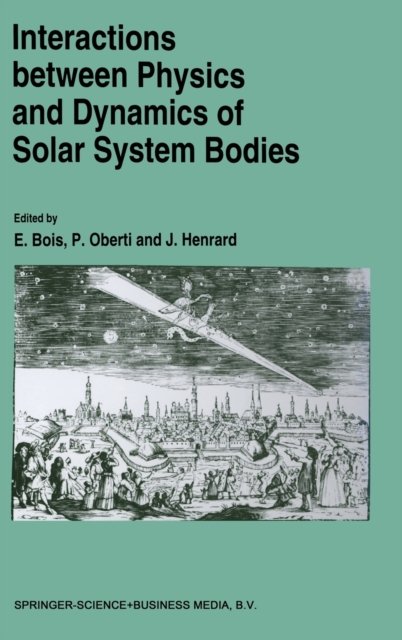
Interactions Between Physics and Dynamics of Solar System Bodies
Redigert av E. Bois, P. Oberti, J. Henrard, etc., 1993.
Proceedings of the International Astronomical Symposium Held in Pleneuf-Val-Andre (France) from June 21-28, 1992
This work contains the proceedings of an International Astronomical Symposium devoted to the interactions between physics and dynamics in the solar system, especially with regard to the small bodies (asteroids, comets, meteors). These two topics were traditionally considered as almost independent, but their interactions are increasingly being reviewed as the key to an understanding of the formation and evolution of the solar system. For instance, the rotational dynamics of planets have a profound influence on their climate. On the other hand, a good understanding of the complicated dynamics of asteroids and the identification of families of bodies born from the break-up of a parent body may tell us much about the formation and the evolution of the solar system. All these, and several related questions are discussed in these proceedings, which should be of interest to both physicists and dynamicists.
Språk: Engelsk
Oppdag mer
Interactions Between Physics and Dynamics of Solar System Bodies
Redigert av E. Bois, P. Oberti, J. Henrard, etc., 1993.
Proceedings of the International Astronomical Symposium Held in Pleneuf-Val-Andre (France) from June 21-28, 1992
This work contains the proceedings of an International Astronomical Symposium devoted to the interactions between physics and dynamics in the solar system, especially with regard to the small bodies (asteroids, comets, meteors). These two topics were traditionally considered as almost independent, but their interactions are increasingly being reviewed as the key to an understanding of the formation and evolution of the solar system. For instance, the rotational dynamics of planets have a profound influence on their climate. On the other hand, a good understanding of the complicated dynamics of asteroids and the identification of families of bodies born from the break-up of a parent body may tell us much about the formation and the evolution of the solar system. All these, and several related questions are discussed in these proceedings, which should be of interest to both physicists and dynamicists.
Oppdag mer
Språk: Engelsk
Ved å fullføre kjøpet aksepterer du kjøpsvilkårene.