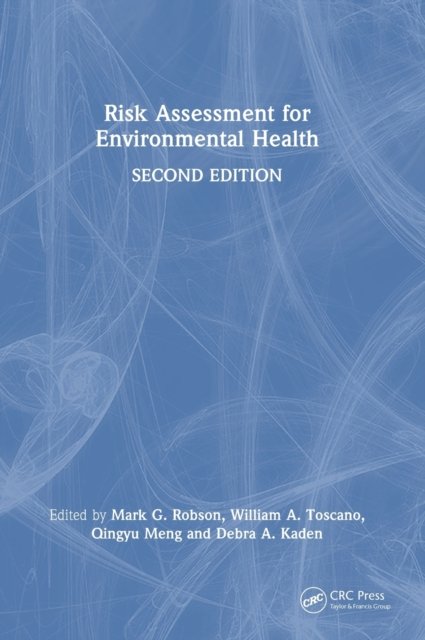
Risk Assessment for Environmental Health
Redigert av Debra A. Kaden, William A. Toscano, Qingyu Meng, Mark G. Robson, 2022.
Understanding risk to humans is one of the most important problems in environmental public health. Risk assessment is constantly changing with the advent of new exposure assessment tools, more sophisticated models, and a better understanding of disease processes. Risk assessment is also gaining greater acceptance in the developing world where major environmental problems exist. Developed in partnership with the Association of Schools of Public Health, this comprehensive text offers a thorough survey of risk assessment, management, and communications as these practices apply to public health.
Key Features:
- Provides a practical overview of environmental risk assessment and its application by discussing the process and providing case studies and examples
- Focuses on tools and approaches used for humans in an environment involving potential chemical hazards
- Fully updated, the first part introduces the underlying principles and techniques of the field, and the second examines case studies in terms of different risk assessment scenarios
- Risk assessment is a core requirement for the MPH degree in environmental health
- Useful “stories” suitable for case studies
Språk: Engelsk
Risk Assessment for Environmental Health
Redigert av Debra A. Kaden, William A. Toscano, Qingyu Meng, Mark G. Robson, 2022.
Understanding risk to humans is one of the most important problems in environmental public health. Risk assessment is constantly changing with the advent of new exposure assessment tools, more sophisticated models, and a better understanding of disease processes. Risk assessment is also gaining greater acceptance in the developing world where major environmental problems exist. Developed in partnership with the Association of Schools of Public Health, this comprehensive text offers a thorough survey of risk assessment, management, and communications as these practices apply to public health.
Key Features:
- Provides a practical overview of environmental risk assessment and its application by discussing the process and providing case studies and examples
- Focuses on tools and approaches used for humans in an environment involving potential chemical hazards
- Fully updated, the first part introduces the underlying principles and techniques of the field, and the second examines case studies in terms of different risk assessment scenarios
- Risk assessment is a core requirement for the MPH degree in environmental health
- Useful “stories” suitable for case studies
Språk: Engelsk
Ved å fullføre kjøpet aksepterer du kjøpsvilkårene.