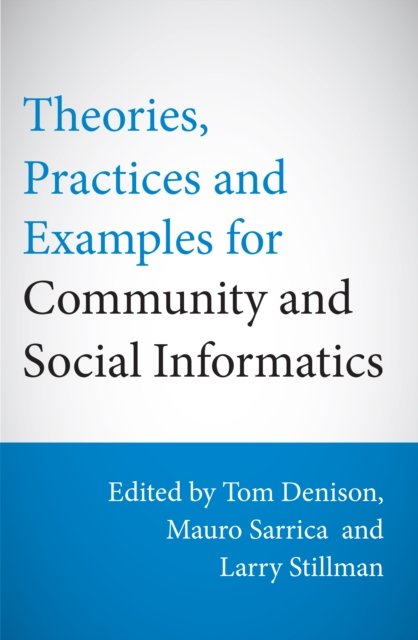
Theories, Practices and Examples for Community and Social Informatics
Redigert av Larry Stillman, Tom Denison, Mauro Sarrica, 2014.
Community Informatics is an emergent discipline with a dual focus: the conduct of research about the relationship between the design of information and communications technologies (ICTs) and local communities; and the implementation of ICT projects in local communities. While most of the Community Informatics literature focuses on empirical work and its relationship to more technically-oriented Information or Management Systems thinking, this book will use a combination of theoretical and case study approaches to explore the relationship between Community Informatics, Social Informatics, and broader social theory. Themes include: social order mediated through ICTs; community and cohesion; class and power; social psychology and technology; the relationship between personal agency and social structure mediated through technology; and the nature of institutional or community formations in the age of ICTs.
Språk: Engelsk
Oppdag mer
Theories, Practices and Examples for Community and Social Informatics
Redigert av Larry Stillman, Tom Denison, Mauro Sarrica, 2014.
Community Informatics is an emergent discipline with a dual focus: the conduct of research about the relationship between the design of information and communications technologies (ICTs) and local communities; and the implementation of ICT projects in local communities. While most of the Community Informatics literature focuses on empirical work and its relationship to more technically-oriented Information or Management Systems thinking, this book will use a combination of theoretical and case study approaches to explore the relationship between Community Informatics, Social Informatics, and broader social theory. Themes include: social order mediated through ICTs; community and cohesion; class and power; social psychology and technology; the relationship between personal agency and social structure mediated through technology; and the nature of institutional or community formations in the age of ICTs.
Oppdag mer
Språk: Engelsk
Ved å fullføre kjøpet aksepterer du kjøpsvilkårene.