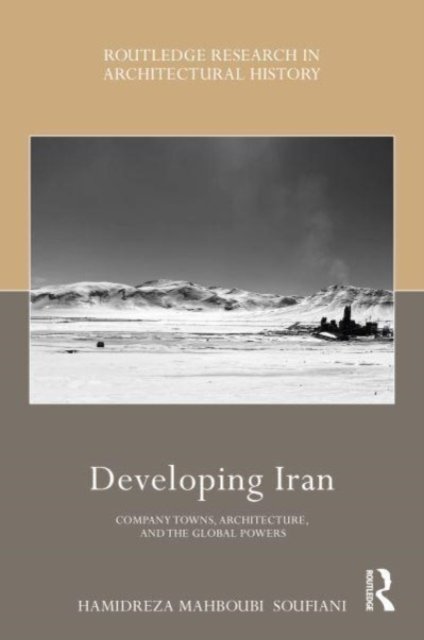

Av Hamidreza Mahboubi Soufiani, 2023.Del av serien Routledge Research in Architectural History.
Company Towns, Architecture, and the Global Powers
This book examines the emergence of modern company towns in Iran by delineating the architectural, political, and industrial histories of three distinct resource-based company town projects built in association with the Big Three powers of World War II.
The books narrative builds upon a tripartite research design that chronologically traces the formation and development of the oil, steel, and copper industries, respectively favoured by Great Britain, the Soviet Union, and the United States in this part of the world. By applying three sets of comparative studies, the book provides critical vantage points to three different ideological design paradigms: postcolonial regionalism, socialist universalism, and rationalist modern nation building. From a global political context, the book contributes to the disclosure of new information about the geopolitical confrontation of these three nations in the Global South to increase their sphere of influence after the Second World War. Furthermore, it demonstrates how postwar architectural modernism was adopted by each power and adapted to their ideological mind frame to fulfil distinct social, cultural, political, and economic targets.
This book examines multiple interconnections between architecture, politics, and industrial development by adopting a transdisciplinary approach based on comprehensive fieldwork, site surveys, and the analysis of original multilingual documents. As such, it will be of interest to researchers and students of architecture, history, international relations, and Middle Eastern studies.
Språk: Engelsk
Ikke tilgjengelig for Klikk&Hent
Midlertidig tomt på lager
Bestillingsvare. Forventes sendt om ca 9 dager

Av Hamidreza Mahboubi Soufiani, 2023.Del av serien Routledge Research in Architectural History.
Company Towns, Architecture, and the Global Powers
This book examines the emergence of modern company towns in Iran by delineating the architectural, political, and industrial histories of three distinct resource-based company town projects built in association with the Big Three powers of World War II.
The books narrative builds upon a tripartite research design that chronologically traces the formation and development of the oil, steel, and copper industries, respectively favoured by Great Britain, the Soviet Union, and the United States in this part of the world. By applying three sets of comparative studies, the book provides critical vantage points to three different ideological design paradigms: postcolonial regionalism, socialist universalism, and rationalist modern nation building. From a global political context, the book contributes to the disclosure of new information about the geopolitical confrontation of these three nations in the Global South to increase their sphere of influence after the Second World War. Furthermore, it demonstrates how postwar architectural modernism was adopted by each power and adapted to their ideological mind frame to fulfil distinct social, cultural, political, and economic targets.
This book examines multiple interconnections between architecture, politics, and industrial development by adopting a transdisciplinary approach based on comprehensive fieldwork, site surveys, and the analysis of original multilingual documents. As such, it will be of interest to researchers and students of architecture, history, international relations, and Middle Eastern studies.
Språk: Engelsk
Ikke tilgjengelig for Klikk&Hent
Midlertidig tomt på lager
Bestillingsvare. Forventes sendt om ca 9 dager
Ved å fullføre kjøpet aksepterer du kjøpsvilkårene.

Nettlager


Nettlager


Nettlager


Nettlager

Nettlager

Nettlager

Nettlager

Nettlager

Nettlager

Nettlager

Nettlager

Nettlager

Nettlager

Nettlager