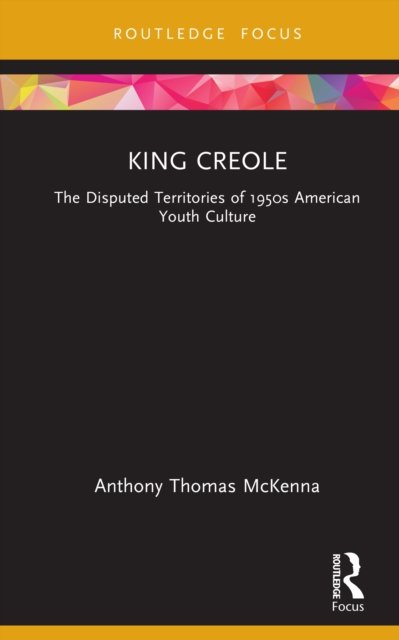
King Creole
Av Anthony Thomas McKenna, 2026.Del av serien Cinema and Youth Cultures.
The Disputed Territories of 1950s American Youth Culture
This book positions King Creole in the disputed territories of 1950s youth culture. It is one of Elvis’s best regarded films, but one of his least financially successful. It is a portrait of youthful alienation and juvenile delinquency made at a time when these topics were becoming less fashionable in teenpics. The author argues that King Creole's release during the death throes of rock and roll in America helps to position it as an outlier among youth films of the time in three distinct ways. First, the author demonstrates how the post-rock and roll release of the film allowed for a better harnessing of the star's 'Elvisness.' Second, the author conducts an extensive examination of the film's production records, which show how the film's portrait of youth alienation and delinquency pre-dated America's big screen fixation on these topics, making the film not wholly bound by concurrent youth conventions. Third, the author challenges the dominant reading of the film as being about intergenerational conflict and asserts that it is about shared grief. This nuanced approach distinguishes King Creole from other 1950s youth-oriented films and explains its enduring critical acclaim despite commercial underperformance. Rich on archival research and textual analysis King Creole: The Disputed Territories of 1950s American Youth Culture will interest both film studies scholars and students. Beyond film studies, this interdisciplinary text is valuable for scholars and students of popular music, American pop culture, celebrity studies, and social history.
Ikke tilgjengelig for Klikk&Hent
Midlertidig tomt på lager
Bestillingsvare. Forventes sendt om ca 11 dager
King Creole
Av Anthony Thomas McKenna, 2026.Del av serien Cinema and Youth Cultures.
The Disputed Territories of 1950s American Youth Culture
This book positions King Creole in the disputed territories of 1950s youth culture. It is one of Elvis’s best regarded films, but one of his least financially successful. It is a portrait of youthful alienation and juvenile delinquency made at a time when these topics were becoming less fashionable in teenpics. The author argues that King Creole's release during the death throes of rock and roll in America helps to position it as an outlier among youth films of the time in three distinct ways. First, the author demonstrates how the post-rock and roll release of the film allowed for a better harnessing of the star's 'Elvisness.' Second, the author conducts an extensive examination of the film's production records, which show how the film's portrait of youth alienation and delinquency pre-dated America's big screen fixation on these topics, making the film not wholly bound by concurrent youth conventions. Third, the author challenges the dominant reading of the film as being about intergenerational conflict and asserts that it is about shared grief. This nuanced approach distinguishes King Creole from other 1950s youth-oriented films and explains its enduring critical acclaim despite commercial underperformance. Rich on archival research and textual analysis King Creole: The Disputed Territories of 1950s American Youth Culture will interest both film studies scholars and students. Beyond film studies, this interdisciplinary text is valuable for scholars and students of popular music, American pop culture, celebrity studies, and social history.
Ikke tilgjengelig for Klikk&Hent
Midlertidig tomt på lager
Bestillingsvare. Forventes sendt om ca 11 dager
Ved å fullføre kjøpet aksepterer du kjøpsvilkårene.