Hopp til hovedinnholdet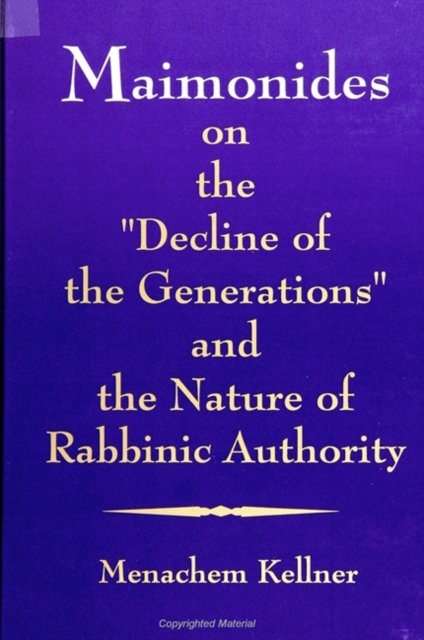
Maimonides on the "Decline of the Generations" and the Nature of Rabbinic Authority
Av Menachem Kellner, 1996.Del av serien SUNY series in Jewish Philosophy.
Shows to what extent and in what fashion Jews are bound to accept the opinions and the pronouncements of religious authorities.
Moses Maimonides, medieval Judaism's leading legist and philosopher, and a figure of central importance for contemporary Jewish self-understanding, held a view of Judaism which maintained the authority of the Talmudic rabbis in matters of Jewish law while allowing for free and open inquiry in matters of science and philosophy. Maimonides affirmed, not the superiority of the "moderns" (the scholars of his and subsequent generations) over the "ancients" (the Tannaim and Amoraim, the Rabbis of the Mishnah and Talmud) but the inherent equality of the two. The equality presented here is not equality of halakhic authority, but equality of ability, of essential human characteristics.
In order to substantiate these claims, Kellner explores the related idea that Maimonides does not adopt the notion of "the decline of the generations," according to which each succeeding generation, or each succeeding epoch, is in some significant and religiously relevant sense inferior to preceding generations or epochs.
PocketEngelsk
Normalpris: 349,-
314,-
Spar 35,-
Ikke tilgjengelig for Klikk&Hent
Midlertidig tomt på lager
Bestillingsvare. Forventes sendt om ca 9 dager
Oppdag mer
Maimonides on the "Decline of the Generations" and the Nature of Rabbinic Authority
Av Menachem Kellner, 1996.Del av serien SUNY series in Jewish Philosophy.
Shows to what extent and in what fashion Jews are bound to accept the opinions and the pronouncements of religious authorities.
Moses Maimonides, medieval Judaism's leading legist and philosopher, and a figure of central importance for contemporary Jewish self-understanding, held a view of Judaism which maintained the authority of the Talmudic rabbis in matters of Jewish law while allowing for free and open inquiry in matters of science and philosophy. Maimonides affirmed, not the superiority of the "moderns" (the scholars of his and subsequent generations) over the "ancients" (the Tannaim and Amoraim, the Rabbis of the Mishnah and Talmud) but the inherent equality of the two. The equality presented here is not equality of halakhic authority, but equality of ability, of essential human characteristics.
In order to substantiate these claims, Kellner explores the related idea that Maimonides does not adopt the notion of "the decline of the generations," according to which each succeeding generation, or each succeeding epoch, is in some significant and religiously relevant sense inferior to preceding generations or epochs.
Oppdag mer
Normalpris: 349,-
314,-
Spar 35,-
PocketEngelsk
Ikke tilgjengelig for Klikk&Hent
Midlertidig tomt på lager
Bestillingsvare. Forventes sendt om ca 9 dager
314,-
Ved å fullføre kjøpet aksepterer du kjøpsvilkårene.