

Hopp til hovedinnholdet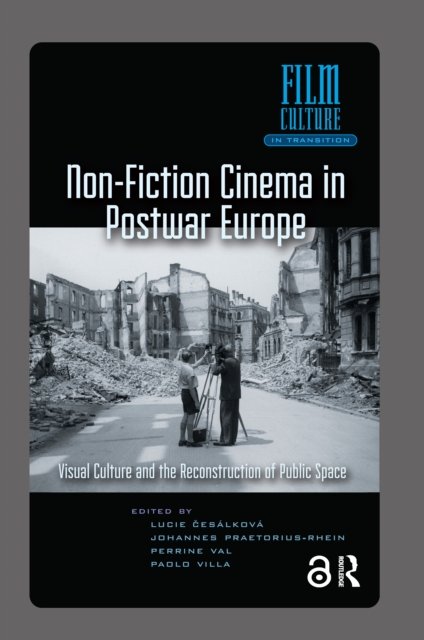
Non-Fiction Cinema in Postwar Europe
Redigert av Johannes Praetorius-Rhein, Perrine Val, Paolo Villa, Lucie Cesalkova, 2025.Del av serien Film Culture in Transition.
Visual Culture and the Reconstruction of Public Space
After WWII, cinema was everywhere: in movie theatres, public squares, factories, schools, trial courts, trains, museums, and political meetings. Seen today, documentaries and newsreels, as well as the amateur production, show the kaleidoscopic portrait of a changing Europe. How did these cinematic images contribute to shaping the new societies emerging from the ashes of war, both in the Western and in the Eastern bloc? Why were they so crucial in framing and regulating new places and practices, political systems, economic dynamics, educational frameworks, and memory communities? This edited volume explores the multiple ways nonfiction cinema reconfigured public spaces, collective participation, democratisation, and governmentality between 1944 and 1956. Looking back at it through a transnational perspective and the critical category of spatiality, nonfiction cinema appears in a new light: simultaneously as a specifically situated and as a highly mobile medium, it was a fundamental agent in reshaping Europe’s shared identity and culture in a defining decade.
Språk: Engelsk
649,-
Ikke tilgjengelig for Klikk&Hent
Midlertidig tomt på lager
Bestillingsvare. Forventes sendt om ca 11 dager
Oppdag mer
Non-Fiction Cinema in Postwar Europe
Redigert av Johannes Praetorius-Rhein, Perrine Val, Paolo Villa, Lucie Cesalkova, 2025.Del av serien Film Culture in Transition.
Visual Culture and the Reconstruction of Public Space
After WWII, cinema was everywhere: in movie theatres, public squares, factories, schools, trial courts, trains, museums, and political meetings. Seen today, documentaries and newsreels, as well as the amateur production, show the kaleidoscopic portrait of a changing Europe. How did these cinematic images contribute to shaping the new societies emerging from the ashes of war, both in the Western and in the Eastern bloc? Why were they so crucial in framing and regulating new places and practices, political systems, economic dynamics, educational frameworks, and memory communities? This edited volume explores the multiple ways nonfiction cinema reconfigured public spaces, collective participation, democratisation, and governmentality between 1944 and 1956. Looking back at it through a transnational perspective and the critical category of spatiality, nonfiction cinema appears in a new light: simultaneously as a specifically situated and as a highly mobile medium, it was a fundamental agent in reshaping Europe’s shared identity and culture in a defining decade.
Oppdag mer
649,-
Språk: Engelsk
Ikke tilgjengelig for Klikk&Hent
Midlertidig tomt på lager
Bestillingsvare. Forventes sendt om ca 11 dager
649,-
Ved å fullføre kjøpet aksepterer du kjøpsvilkårene.