Pensum -10%
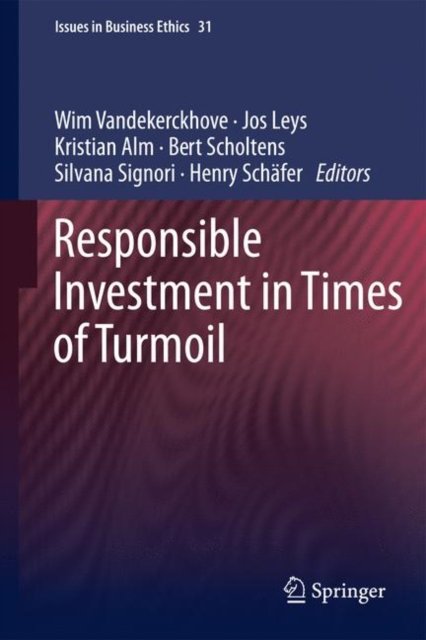
Redigert av Bert Scholtens, Wim Vandekerckhove, Silvana Signori, Kristian Alm, Jos Leys, Henry Schafer, 2011.Del av serien Issues in Business Ethics.
The SRI phenomenon is said to be entering the mainstream of financial intermediation. From a fairly marginal practice promoted or campaigned for by NGO's and at odds with financial practice and orthodoxy it grew into well formulated policy adopted by a wide range of investors. Academic literature on SRI has also boomed on the assumption that mainstreaming is taking place. However, little thinking has been carried out on questions specifically arising from this alleged 'mainstreaming'. This book, addressed to those with a scholarly or practitioner's interest in SRI, starts filling this neglected dimension.
Today, one cannot ignore the difficulties of main stream financing. The financial spheres are trembling globally in one of the worst crises since the 1930's. As a response to the crisis, the intermediation of 'financial responsibility' will undoubtedly be the subject of new regulation and scrutinizing. This book looks into what these turbulences will imply for SRI.
In view of these circumstances, one might or even should, ask oneself whether the phenomenon was not an empty fad during the exuberant high of financial euphoria that came abruptly to an end with current financial crises. To put it rather sec: are financial intermediaries that promote 'sustainability' credible, while it is obvious that some developments in financial intermediation -predictably, as some say- were unsustainable?
Is this an opportunity for enhancing SRI because of the strength and superiority it has developed or will it disappear due to a return to financial myopia? This book is the first to question the future of SRI in such a radical way.
Ikke tilgjengelig for Klikk&Hent
Midlertidig tomt på lager
Bestillingsvare. Forventes sendt om ca 20 dager
Redigert av Bert Scholtens, Wim Vandekerckhove, Silvana Signori, Kristian Alm, Jos Leys, Henry Schafer, 2011.Del av serien Issues in Business Ethics.
The SRI phenomenon is said to be entering the mainstream of financial intermediation. From a fairly marginal practice promoted or campaigned for by NGO's and at odds with financial practice and orthodoxy it grew into well formulated policy adopted by a wide range of investors. Academic literature on SRI has also boomed on the assumption that mainstreaming is taking place. However, little thinking has been carried out on questions specifically arising from this alleged 'mainstreaming'. This book, addressed to those with a scholarly or practitioner's interest in SRI, starts filling this neglected dimension.
Today, one cannot ignore the difficulties of main stream financing. The financial spheres are trembling globally in one of the worst crises since the 1930's. As a response to the crisis, the intermediation of 'financial responsibility' will undoubtedly be the subject of new regulation and scrutinizing. This book looks into what these turbulences will imply for SRI.
In view of these circumstances, one might or even should, ask oneself whether the phenomenon was not an empty fad during the exuberant high of financial euphoria that came abruptly to an end with current financial crises. To put it rather sec: are financial intermediaries that promote 'sustainability' credible, while it is obvious that some developments in financial intermediation -predictably, as some say- were unsustainable?
Is this an opportunity for enhancing SRI because of the strength and superiority it has developed or will it disappear due to a return to financial myopia? This book is the first to question the future of SRI in such a radical way.
Ikke tilgjengelig for Klikk&Hent
Midlertidig tomt på lager
Bestillingsvare. Forventes sendt om ca 20 dager
Ved å fullføre kjøpet aksepterer du kjøpsvilkårene.

The Shame of Reason in Organizational Change
1 124,-

Managing Care: A Shared Responsibility
1 592,-

Multinational Corporations and the Impact of Public Advocacy on Corporate Strategy
1 592,-

Contemporary Reflections on Business Ethics
1 124,-
The Shame of Reason in Organizational Change
1 124,-

Cutting-edge Issues in Business Ethics
1 124,-

The Search for Ethics in Leadership, Business, and Beyond
971,-

Arriving Where We Started
584,-

Humanizing Business
1 466,-

Contemporary Reflections on Business Ethics
674,-
The Shame of Reason in Organizational Change
1 124,-
Managing Care: A Shared Responsibility
1 592,-
Multinational Corporations and the Impact of Public Advocacy on Corporate Strategy
1 592,-
Contemporary Reflections on Business Ethics
1 124,-
The Shame of Reason in Organizational Change
1 124,-
Cutting-edge Issues in Business Ethics
1 124,-
The Search for Ethics in Leadership, Business, and Beyond
971,-
Arriving Where We Started
584,-
Humanizing Business
1 466,-
Contemporary Reflections on Business Ethics
674,-