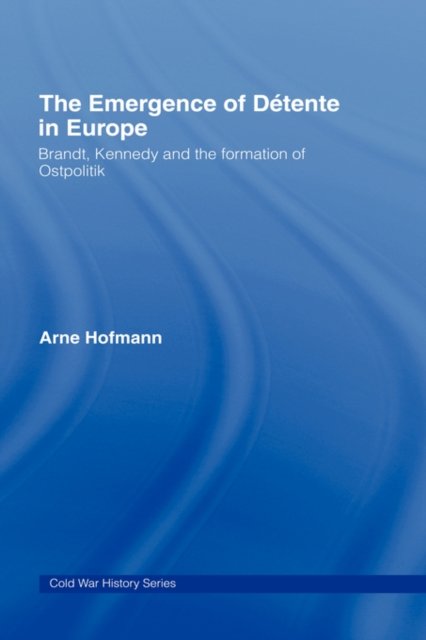
The Emergence of Detente in Europe
Av Arne Hofmann, 2007.Del av serien Cold War History.
Brandt, Kennedy and the Formation of Ostpolitik
This book examines the key relationship between Willy Brandt (the former Mayor of West Berlin and future West German Chancellor) and the administration of President John F. Kennedy.
Arne Hofmann focuses on the administration?s influence on the development of Brandt?s ?policy of small steps? and the formation of his later Ostpolitik, the centrepiece of European détente. Brandt?s interaction with the Kennedy administration is traced through the Berlin Wall crisis of 1961, together with Kennedy?s search for a modus vivendi based on the status quo, the 1962 crisis in German-American relations, Brandt?s disillusionment campaign, the development of his programmatic statements, Brandt?s three meetings with the President including Kennedy?s famous visit to Berlin, the limited nuclear test ban treaty and Brandt?s Berlin pass agreement of Christmas 1963. While the narrative focuses on the gradual change in Brandt?s position, systematic parts concentrate on Brandt?s and Kennedy?s détente concepts, the triangular relationship between West Berlin, Washington and Bonn with its implication for domestic politics, and the role of images, campaigning and public opinion.
The Emergence of Détente in Europe will appeal to students of Cold War history, foreign policy, international relations and international history in general.
Ikke tilgjengelig for Klikk&Hent
Midlertidig tomt på lager
Bestillingsvare. Forventes sendt om ca 10 dager
Oppdag mer
The Emergence of Detente in Europe
Av Arne Hofmann, 2007.Del av serien Cold War History.
Brandt, Kennedy and the Formation of Ostpolitik
This book examines the key relationship between Willy Brandt (the former Mayor of West Berlin and future West German Chancellor) and the administration of President John F. Kennedy.
Arne Hofmann focuses on the administration?s influence on the development of Brandt?s ?policy of small steps? and the formation of his later Ostpolitik, the centrepiece of European détente. Brandt?s interaction with the Kennedy administration is traced through the Berlin Wall crisis of 1961, together with Kennedy?s search for a modus vivendi based on the status quo, the 1962 crisis in German-American relations, Brandt?s disillusionment campaign, the development of his programmatic statements, Brandt?s three meetings with the President including Kennedy?s famous visit to Berlin, the limited nuclear test ban treaty and Brandt?s Berlin pass agreement of Christmas 1963. While the narrative focuses on the gradual change in Brandt?s position, systematic parts concentrate on Brandt?s and Kennedy?s détente concepts, the triangular relationship between West Berlin, Washington and Bonn with its implication for domestic politics, and the role of images, campaigning and public opinion.
The Emergence of Détente in Europe will appeal to students of Cold War history, foreign policy, international relations and international history in general.
Oppdag mer
Ikke tilgjengelig for Klikk&Hent
Midlertidig tomt på lager
Bestillingsvare. Forventes sendt om ca 10 dager
Ved å fullføre kjøpet aksepterer du kjøpsvilkårene.