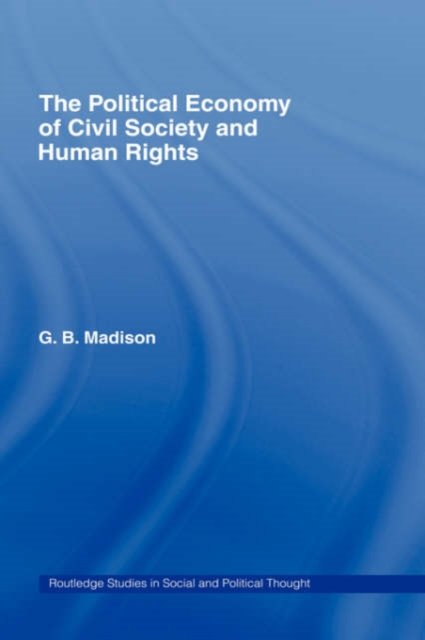
The Political Economy of Civil Society and Human Rights
Av Gary B. Madison, 1998.Del av serien Routledge Studies in Social and Political Thought.
Madison uses the concept of civil society and his distinctive version of 'communicative rationality' to provide a closely-argued and robust defence of the neo-liberal political and economic tradition.
Writing with considerable elegance and humour, the author draws on the hermeneutical and neo-pragmatist traditions, and on a diverse range of evidence and discussion, mainly concerning transitional economies and societies in Eastern Europe and around the world. Providing a systematic analysis of the multi-faceted notion of civil society, this book shows in detail how the three main orders of civil society - the moral-cultural, the political, and the economic - constitute 'spheres of autonomy'. At the same time, it illustrates how these different orders are closely interrelated and interact in a synergetic manner. A unique feature of this study is the way in which the author demonstrates how the logic of the various orders of civil society is, in a way appropriate to the distinct nature of each order, a logic of communicative rationality. The work concludes by arguing that the only sure way of achieving international justice is by the construction of civil society world-wide.
Språk: Engelsk
Ikke tilgjengelig for Klikk&Hent
Midlertidig tomt på lager
Bestillingsvare. Forventes sendt om ca 10 dager
The Political Economy of Civil Society and Human Rights
Av Gary B. Madison, 1998.Del av serien Routledge Studies in Social and Political Thought.
Madison uses the concept of civil society and his distinctive version of 'communicative rationality' to provide a closely-argued and robust defence of the neo-liberal political and economic tradition.
Writing with considerable elegance and humour, the author draws on the hermeneutical and neo-pragmatist traditions, and on a diverse range of evidence and discussion, mainly concerning transitional economies and societies in Eastern Europe and around the world. Providing a systematic analysis of the multi-faceted notion of civil society, this book shows in detail how the three main orders of civil society - the moral-cultural, the political, and the economic - constitute 'spheres of autonomy'. At the same time, it illustrates how these different orders are closely interrelated and interact in a synergetic manner. A unique feature of this study is the way in which the author demonstrates how the logic of the various orders of civil society is, in a way appropriate to the distinct nature of each order, a logic of communicative rationality. The work concludes by arguing that the only sure way of achieving international justice is by the construction of civil society world-wide.
Språk: Engelsk
Ikke tilgjengelig for Klikk&Hent
Midlertidig tomt på lager
Bestillingsvare. Forventes sendt om ca 10 dager
Ved å fullføre kjøpet aksepterer du kjøpsvilkårene.