Pensum -10%
Av Ltd. Huawei Technologies Co., 2022.
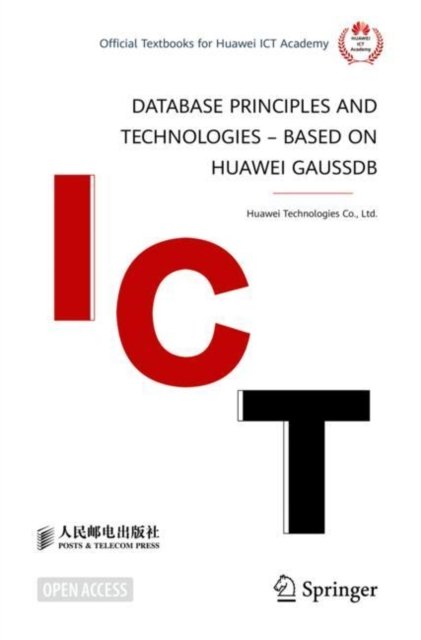
This open access book contains eight chapters that deal with database technologies, including the development history of database, database fundamentals, introduction to SQL syntax, classification of SQL syntax, database security fundamentals, database development environment, database design fundamentals, and the application of Huawei's cloud database product GaussDB database.
This book can be used as a textbook for database courses in colleges and universities, and is also suitable as a reference book for the HCIA-GaussDB V1.5 certification examination. The Huawei GaussDB (for MySQL) used in the book is a Huawei cloud-based high-performance, highly applicable relational database that fully supports the syntax and functionality of the open source database MySQL. All the experiments in this book can be run on this database platform.
As the world's leading provider of ICT (information and communication technology) infrastructure and smart terminals, Huawei's products range from digital data communication, cyber security, wireless technology, data storage, cloud computing, and smart computing to artificial intelligence.
Ikke tilgjengelig for Klikk&Hent
Midlertidig tomt på lager
Bestillingsvare. Forventes sendt om ca 20 dager
Av Ltd. Huawei Technologies Co., 2022.
This open access book contains eight chapters that deal with database technologies, including the development history of database, database fundamentals, introduction to SQL syntax, classification of SQL syntax, database security fundamentals, database development environment, database design fundamentals, and the application of Huawei's cloud database product GaussDB database.
This book can be used as a textbook for database courses in colleges and universities, and is also suitable as a reference book for the HCIA-GaussDB V1.5 certification examination. The Huawei GaussDB (for MySQL) used in the book is a Huawei cloud-based high-performance, highly applicable relational database that fully supports the syntax and functionality of the open source database MySQL. All the experiments in this book can be run on this database platform.
As the world's leading provider of ICT (information and communication technology) infrastructure and smart terminals, Huawei's products range from digital data communication, cyber security, wireless technology, data storage, cloud computing, and smart computing to artificial intelligence.
Ikke tilgjengelig for Klikk&Hent
Midlertidig tomt på lager
Bestillingsvare. Forventes sendt om ca 20 dager
Ved å fullføre kjøpet aksepterer du kjøpsvilkårene.