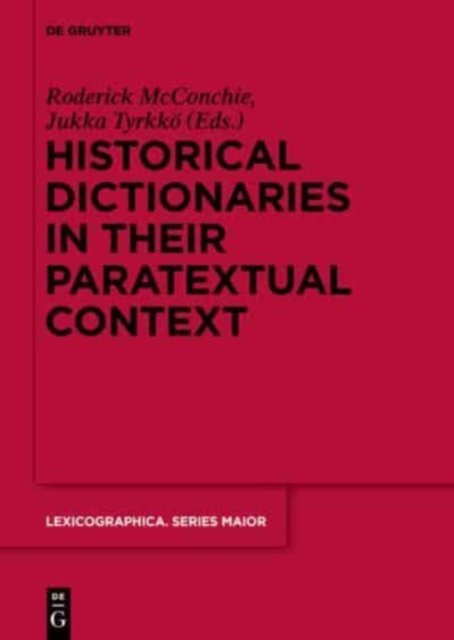
Historical Dictionaries in Their Paratextual Context
Jukka Tyrkkö, Roderick McConchie
InnbundetEngelsk
Del av serien Lexicographica. Series Maior
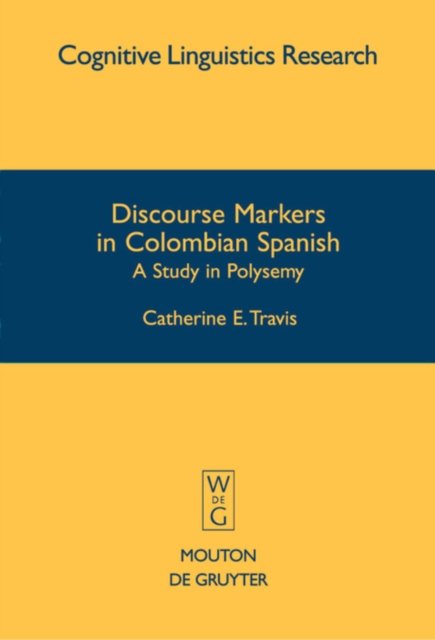
Av Catherine E. Travis, 2005.Del av serien Cognitive Linguistics Research [CLR].
A Study in Polysemy
This book presents a semantic analysis of a set of four functionally related discourse markers that are particularly frequent in conversational Colombian Spanish. A corpus of four hours of spontaneous conversation is used to study the markers bueno 'well, OK', pues 'well, then', o sea 'I mean, that is to say' and entonces 'so, then'.
Through a detailed analysis of numerous examples drawn from the corpus, and employing both quantitative and qualitative techniques, it is demonstrated that, contrary to popular belief, discourse markers are not just functional particles with indeterminate or context-based semantics. Rather, they have inherent meanings which can be identified and exhaustively defined with an appropriate semantic methodology, such as is provided by the Natural Semantic Metalanguage approach. This study illustrates that this approach, which has been widely applied to the semantics of the lexicon and the grammar, can be extended to the semantics of discourse-based features, supporting the notion that meaning of all aspects of language forms one semantic system.
This research also has implications for the study of polysemy, in that it operationalizes the little understood, but classical definition of polysemy of items with 'a shared element of meaning', and it demonstrates that the polysemous relations of discourse markers are centered around an invariant core that can be identified on the basis of their use in discourse. As one of the first corpus-based studies to present a semantic account of the multifunctional nature of discourse markers this book makes an important contribution to research on the relationship between semantics and discourse-pragmatics, and polysemy in discourse.
Ikke tilgjengelig for Klikk&Hent
Midlertidig tomt på lager
Bestillingsvare. Forventes sendt om ca 14 dager
Av Catherine E. Travis, 2005.Del av serien Cognitive Linguistics Research [CLR].
A Study in Polysemy
This book presents a semantic analysis of a set of four functionally related discourse markers that are particularly frequent in conversational Colombian Spanish. A corpus of four hours of spontaneous conversation is used to study the markers bueno 'well, OK', pues 'well, then', o sea 'I mean, that is to say' and entonces 'so, then'.
Through a detailed analysis of numerous examples drawn from the corpus, and employing both quantitative and qualitative techniques, it is demonstrated that, contrary to popular belief, discourse markers are not just functional particles with indeterminate or context-based semantics. Rather, they have inherent meanings which can be identified and exhaustively defined with an appropriate semantic methodology, such as is provided by the Natural Semantic Metalanguage approach. This study illustrates that this approach, which has been widely applied to the semantics of the lexicon and the grammar, can be extended to the semantics of discourse-based features, supporting the notion that meaning of all aspects of language forms one semantic system.
This research also has implications for the study of polysemy, in that it operationalizes the little understood, but classical definition of polysemy of items with 'a shared element of meaning', and it demonstrates that the polysemous relations of discourse markers are centered around an invariant core that can be identified on the basis of their use in discourse. As one of the first corpus-based studies to present a semantic account of the multifunctional nature of discourse markers this book makes an important contribution to research on the relationship between semantics and discourse-pragmatics, and polysemy in discourse.
Ikke tilgjengelig for Klikk&Hent
Midlertidig tomt på lager
Bestillingsvare. Forventes sendt om ca 14 dager
Ved å fullføre kjøpet aksepterer du kjøpsvilkårene.




Viewpoint and the Fabric of Meaning
1 669,-
Viewpoint and the Fabric of Meaning
299,-
Grounding
1 682,-
Quantitative Methods in Cognitive Semantics: Corpus-Driven Approaches
2 138,-
Concept, Image, and Symbol
1 389,-
Geography of Case Semantics
1 629,-
Conceptualizations and Mental Processing in Language
2 899,-
Grammar in Mind and Brain
1 629,-
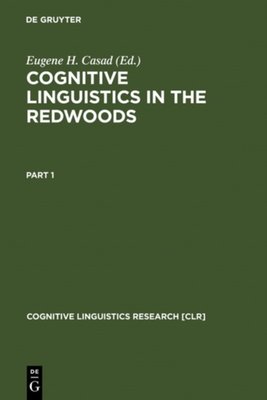
Cognitive Linguistics in the Redwoods
3 549,-
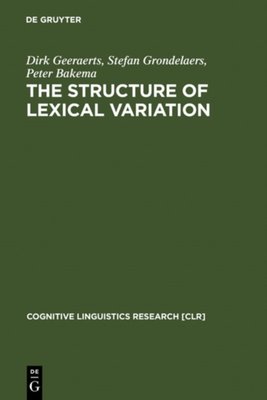
Structure of Lexical Variation
1 389,-
Viewpoint and the Fabric of Meaning
1 669,-
Viewpoint and the Fabric of Meaning
299,-
Grounding
1 682,-
Quantitative Methods in Cognitive Semantics: Corpus-Driven Approaches
2 138,-
Concept, Image, and Symbol
1 389,-
Geography of Case Semantics
1 629,-
Conceptualizations and Mental Processing in Language
2 899,-
Grammar in Mind and Brain
1 629,-
Cognitive Linguistics in the Redwoods
3 549,-
Structure of Lexical Variation
1 389,-