Pensum -10%
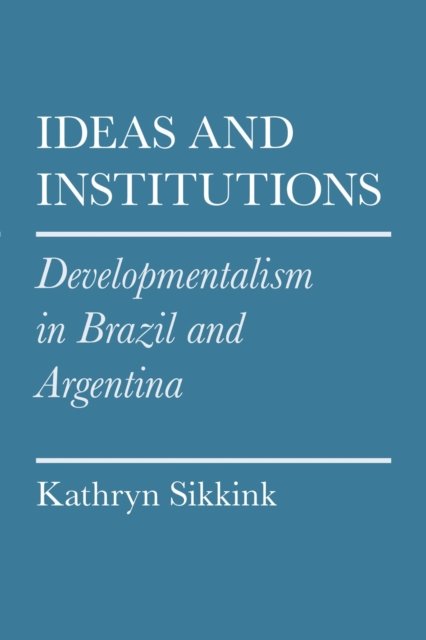
Av Kathryn A. Sikkink, 2012.Del av serien Cornell Studies in Political Economy.
Developmentalism in Brazil and Argentina
In Ideas and Institutions, Kathryn Sikkink illuminates a key question in contemporary political economy: What power do ideas wield in the world of politics and policy? Sikkink traces the effects of one enormously influential set of ideas, developmentalism, on the two largest economies in Latin America, Brazil and Argentina.
Introduced under the intellectual leadership of Raúl Prebisch at the U.N. Economic Commission for Latin America, developmentalism was embraced as national policy in many postwar developing economies. Drawing upon extensive archival research and interviews, Sikkink explores the adoption, implementation, and consolidation of the developmentalist model of economic policy in Brazil and Argentina in the 1950s and 1960s, focusing on the governments of Juscelino Kubitschek and Arturo Frondizi, respectively.
In accounting for the initial decision to adopt developmentalist policies in Latin America and the persistence of the policy package in the region, she highlights the importance of political and economic ideas, the comparative effects of different national institutions, and the variable ability of political leaders to mobilize resources and support.
Ikke tilgjengelig for Klikk&Hent
Midlertidig tomt på lager
Bestillingsvare. Forventes sendt om ca 11 dager
Av Kathryn A. Sikkink, 2012.Del av serien Cornell Studies in Political Economy.
Developmentalism in Brazil and Argentina
In Ideas and Institutions, Kathryn Sikkink illuminates a key question in contemporary political economy: What power do ideas wield in the world of politics and policy? Sikkink traces the effects of one enormously influential set of ideas, developmentalism, on the two largest economies in Latin America, Brazil and Argentina.
Introduced under the intellectual leadership of Raúl Prebisch at the U.N. Economic Commission for Latin America, developmentalism was embraced as national policy in many postwar developing economies. Drawing upon extensive archival research and interviews, Sikkink explores the adoption, implementation, and consolidation of the developmentalist model of economic policy in Brazil and Argentina in the 1950s and 1960s, focusing on the governments of Juscelino Kubitschek and Arturo Frondizi, respectively.
In accounting for the initial decision to adopt developmentalist policies in Latin America and the persistence of the policy package in the region, she highlights the importance of political and economic ideas, the comparative effects of different national institutions, and the variable ability of political leaders to mobilize resources and support.
Ikke tilgjengelig for Klikk&Hent
Midlertidig tomt på lager
Bestillingsvare. Forventes sendt om ca 11 dager
Ved å fullføre kjøpet aksepterer du kjøpsvilkårene.











Beyond Japan
431,-
A World of Regions
269,-

A Certain Idea of Europe
413,-
Networked Politics
350,-
Constructing the International Economy
395,-

Whose Ideas Matter?
377,-
Hierarchy in International Relations
350,-

China''s Regulatory State
359,-

Politics in the New Hard Times
314,-
Mirrors of the Economy
467,-
Beyond Japan
431,-
A World of Regions
269,-
A Certain Idea of Europe
413,-
Networked Politics
350,-
Constructing the International Economy
395,-
Whose Ideas Matter?
377,-
Hierarchy in International Relations
350,-
China''s Regulatory State
359,-
Politics in the New Hard Times
314,-
Mirrors of the Economy
467,-