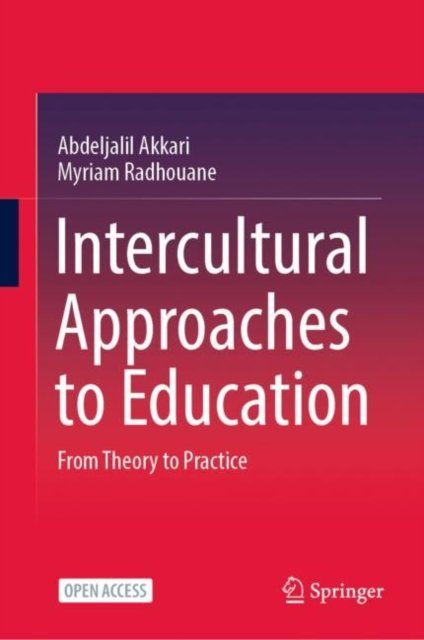
Intercultural Approaches to Education
Av Abdeljalil Akkari, Myriam Radhouane, 2022.
From Theory to Practice
This open access book provides an analysis of contemporary societies and schools shaped by cultural diversity, globalization and migration. This diversity is necessarily reflected in education systems and requires the promotion of intercultural approaches able to improve learning processes and the quality of education.
From an international and comparative perspective, this book first presents theoretical and conceptual foundations for seriously considering cultural diversity. The book also compares intercultural approaches and debates generated in countries as diverse as the United States, Canada, Brazil, Switzerland and France. For each national context, the book addresses both the historical roots of intercultural approaches and the concrete initiatives driven by educational policies for their implementation in schools and classrooms. Finally, the book presents discussions surrounding the treatment of linguistic or religious diversity in schools, the emergence of global citizenship education and the key role of teachers in intercultural approaches.
This is an open access book.
Ikke tilgjengelig for Klikk&Hent
Midlertidig tomt på lager
Bestillingsvare. Forventes sendt om ca 20 dager
Oppdag mer
Intercultural Approaches to Education
Av Abdeljalil Akkari, Myriam Radhouane, 2022.
From Theory to Practice
This open access book provides an analysis of contemporary societies and schools shaped by cultural diversity, globalization and migration. This diversity is necessarily reflected in education systems and requires the promotion of intercultural approaches able to improve learning processes and the quality of education.
From an international and comparative perspective, this book first presents theoretical and conceptual foundations for seriously considering cultural diversity. The book also compares intercultural approaches and debates generated in countries as diverse as the United States, Canada, Brazil, Switzerland and France. For each national context, the book addresses both the historical roots of intercultural approaches and the concrete initiatives driven by educational policies for their implementation in schools and classrooms. Finally, the book presents discussions surrounding the treatment of linguistic or religious diversity in schools, the emergence of global citizenship education and the key role of teachers in intercultural approaches.
This is an open access book.
Oppdag mer
Ikke tilgjengelig for Klikk&Hent
Midlertidig tomt på lager
Bestillingsvare. Forventes sendt om ca 20 dager
Ved å fullføre kjøpet aksepterer du kjøpsvilkårene.