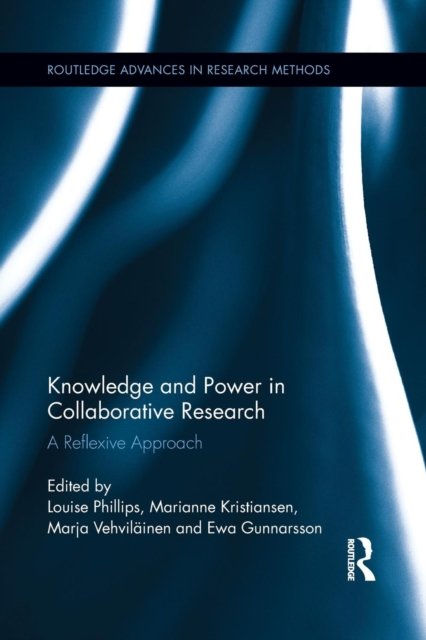
Knowledge and Power in Collaborative Research
Redigert av Ewa Gunnarsson, Louise Phillips, Marianne Kristiansen, Marja Vehviläinen, 2015.Del av serien Routledge Advances in Research Methods.
A Reflexive Approach
Collaborative research embraces a multiplicity of practices in which social actors are invited to participate in the research process as co-producers of knowledge. But what is actually meant by “co-production” in collaborative research? Knowledge and Power in Collaborative Research presents a range of critical, reflexive strategies for understanding and tackling the challenges emanating from the tensions that arise in the meeting between different participants, knowledge forms and knowledge interests. The chapters anchor discussion of ethical, epistemological and methodological questions in sustained empirical analyses of cases of collaborative knowledge production.
The book covers diverse theoretical approaches such as dialogic communication theory, actor network theory, poststructuralist writing as inquiry, institutional ethnography, dialogic action research, and pragmatic action research. The empirical cases span a broad spectrum of empirical fields of social practice: health services, organisational change, research, science communication, environmental communication in intermediary NGOs, participatory governance in relation to urban planning, and digital communication and virtual worlds.
Språk: Engelsk
Ikke tilgjengelig for Klikk&Hent
Midlertidig tomt på lager
Bestillingsvare. Forventes sendt om ca 10 dager
Oppdag mer
Knowledge and Power in Collaborative Research
Redigert av Ewa Gunnarsson, Louise Phillips, Marianne Kristiansen, Marja Vehviläinen, 2015.Del av serien Routledge Advances in Research Methods.
A Reflexive Approach
Collaborative research embraces a multiplicity of practices in which social actors are invited to participate in the research process as co-producers of knowledge. But what is actually meant by “co-production” in collaborative research? Knowledge and Power in Collaborative Research presents a range of critical, reflexive strategies for understanding and tackling the challenges emanating from the tensions that arise in the meeting between different participants, knowledge forms and knowledge interests. The chapters anchor discussion of ethical, epistemological and methodological questions in sustained empirical analyses of cases of collaborative knowledge production.
The book covers diverse theoretical approaches such as dialogic communication theory, actor network theory, poststructuralist writing as inquiry, institutional ethnography, dialogic action research, and pragmatic action research. The empirical cases span a broad spectrum of empirical fields of social practice: health services, organisational change, research, science communication, environmental communication in intermediary NGOs, participatory governance in relation to urban planning, and digital communication and virtual worlds.
Oppdag mer
Språk: Engelsk
Ikke tilgjengelig for Klikk&Hent
Midlertidig tomt på lager
Bestillingsvare. Forventes sendt om ca 10 dager
Ved å fullføre kjøpet aksepterer du kjøpsvilkårene.