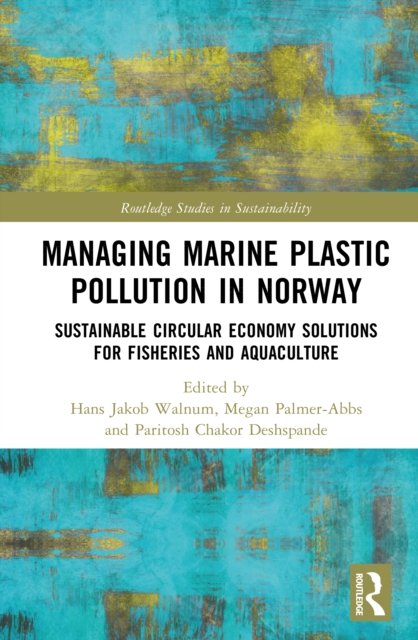
Redigert av Hans Jakob Walnum, Paritosh C. Deshpande, Megan Palmer-Abbs, 2026.Del av serien Routledge Studies in Sustainability.
Sustainable Circular Economy Solutions for Fisheries and Aquaculture
Based on the collaborative, interdisciplinary research project Shift-Plastics this book establish sustainable circular value chains for managing plastics in the fisheries and aquaculture industries, which are significant causes of ocean plastic pollution. Focused on reducing plastic production and consumption by examining the entire life cycle and taking upstream measures, the Norwegian case presented in this book highlights globally relevant insights into how to manage the complexity of plastic pollution and the systemic changes needed for a sustainable circular economy (SCE). This book takes a transdisciplinary approach, incorporating academic perspectives and collaborating with industry and public bodies to improve plastic handling in the fisheries and aquaculture industries. It integrates multiple scientific disciplines, including technological science, policy science, economics, environmental science, design thinking, and systems thinking. It also investigates the value chain of plastic use in the fisheries and aquaculture industries to map their management practices and pinpoint issues that can be improved throughout the process. In doing so, it provides practical advice on how to create effective policies in line with a SCE for both businesses and policymakers. Further, it highlights how plastic production can be reduced through extended usability, ways to apply eco-design principles to create products that can easily be disassembled, repaired, and recycled, and options for using bioplastics and recycled materials. Finally, it presents a roadmap that connects changes in industrial practices, infrastructure needs and policy design in the short, medium, and long term to achieve reduced plastic use and plastic pollution in the fisheries and aquaculture industries. Managing Marine Plastic Pollution in Norway will be an important research reference and tool for academics, students, policymakers, industry and business professionals in pollution and waste management, sustainability, circular economy, and marine, fishery, and environmental management. The Open Access version of this book, available at www.taylorfrancis.com, has been made available under a Creative Commons Attribution-Non Commercial-No Derivatives (CC BY-NC-ND) 4.0 International license.
Ikke tilgjengelig for Klikk&Hent
Midlertidig tomt på lager
Bestillingsvare. Forventes sendt om ca 13 dager

Redigert av Hans Jakob Walnum, Paritosh C. Deshpande, Megan Palmer-Abbs, 2026.Del av serien Routledge Studies in Sustainability.
Sustainable Circular Economy Solutions for Fisheries and Aquaculture
Based on the collaborative, interdisciplinary research project Shift-Plastics this book establish sustainable circular value chains for managing plastics in the fisheries and aquaculture industries, which are significant causes of ocean plastic pollution. Focused on reducing plastic production and consumption by examining the entire life cycle and taking upstream measures, the Norwegian case presented in this book highlights globally relevant insights into how to manage the complexity of plastic pollution and the systemic changes needed for a sustainable circular economy (SCE). This book takes a transdisciplinary approach, incorporating academic perspectives and collaborating with industry and public bodies to improve plastic handling in the fisheries and aquaculture industries. It integrates multiple scientific disciplines, including technological science, policy science, economics, environmental science, design thinking, and systems thinking. It also investigates the value chain of plastic use in the fisheries and aquaculture industries to map their management practices and pinpoint issues that can be improved throughout the process. In doing so, it provides practical advice on how to create effective policies in line with a SCE for both businesses and policymakers. Further, it highlights how plastic production can be reduced through extended usability, ways to apply eco-design principles to create products that can easily be disassembled, repaired, and recycled, and options for using bioplastics and recycled materials. Finally, it presents a roadmap that connects changes in industrial practices, infrastructure needs and policy design in the short, medium, and long term to achieve reduced plastic use and plastic pollution in the fisheries and aquaculture industries. Managing Marine Plastic Pollution in Norway will be an important research reference and tool for academics, students, policymakers, industry and business professionals in pollution and waste management, sustainability, circular economy, and marine, fishery, and environmental management. The Open Access version of this book, available at www.taylorfrancis.com, has been made available under a Creative Commons Attribution-Non Commercial-No Derivatives (CC BY-NC-ND) 4.0 International license.
Ikke tilgjengelig for Klikk&Hent
Midlertidig tomt på lager
Bestillingsvare. Forventes sendt om ca 13 dager
Ved å fullføre kjøpet aksepterer du kjøpsvilkårene.