Pensum -10%

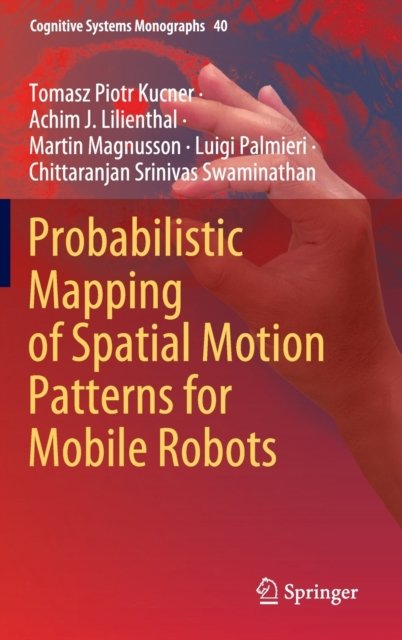
Av Achim J. Lilienthal, Tomasz Piotr Kucner, Martin Magnusson, Luigi Palmieri, Chittaranjan Srinivas Swaminathan, 2020.Del av serien Cognitive Systems Monographs.
This book describes how robots can make sense of motion in their surroundings and use the patterns they observe to blend in better in dynamic environments shared with humans.The world around us is constantly changing. Nonetheless, we can find our way and aren’t overwhelmed by all the buzz, since motion often follows discernible patterns. Just like humans, robots need to understand the patterns behind the dynamics in their surroundings to be able to efficiently operate e.g. in a busy airport. Yet robotic mapping has traditionally been based on the static world assumption, which disregards motion altogether. In this book, the authors describe how robots can instead explicitly learn patterns of dynamic change from observations, store those patterns in Maps of Dynamics (MoDs), and use MoDs to plan less intrusive, safer and more efficient paths. The authors discuss the pros and cons of recently introduced MoDs and approaches to MoD-informed motion planning, and provide an outlook on future work in this emerging, fascinating field.
Språk: Engelsk
Ikke tilgjengelig for Klikk&Hent
Midlertidig tomt på lager
Bestillingsvare. Forventes sendt om ca 20 dager
Av Achim J. Lilienthal, Tomasz Piotr Kucner, Martin Magnusson, Luigi Palmieri, Chittaranjan Srinivas Swaminathan, 2020.Del av serien Cognitive Systems Monographs.
This book describes how robots can make sense of motion in their surroundings and use the patterns they observe to blend in better in dynamic environments shared with humans.The world around us is constantly changing. Nonetheless, we can find our way and aren’t overwhelmed by all the buzz, since motion often follows discernible patterns. Just like humans, robots need to understand the patterns behind the dynamics in their surroundings to be able to efficiently operate e.g. in a busy airport. Yet robotic mapping has traditionally been based on the static world assumption, which disregards motion altogether. In this book, the authors describe how robots can instead explicitly learn patterns of dynamic change from observations, store those patterns in Maps of Dynamics (MoDs), and use MoDs to plan less intrusive, safer and more efficient paths. The authors discuss the pros and cons of recently introduced MoDs and approaches to MoD-informed motion planning, and provide an outlook on future work in this emerging, fascinating field.
Språk: Engelsk
Ikke tilgjengelig for Klikk&Hent
Midlertidig tomt på lager
Bestillingsvare. Forventes sendt om ca 20 dager
Ved å fullføre kjøpet aksepterer du kjøpsvilkårene.











Visual Perception for Humanoid Robots
1 124,-
The Twenty-First Century Mechanistic Theory of Human Cognition
1 709,-

The Psychology of Artificial Superintelligence
1 592,-

Eco-Cognitive Computationalism
1 124,-

Anticipation Across Disciplines
1 124,-
Multimodal Computational Attention for Scene Understanding and Robotics
1 124,-

The Evolved Athlete
1 124,-
Engineering Computational Emotion - A Reference Model for Emotion in Artificial Systems
1 124,-
Modeling, Simulation and Optimization of Bipedal Walking
1 124,-
The Playful Machine
1 124,-
Visual Perception for Humanoid Robots
1 124,-
The Twenty-First Century Mechanistic Theory of Human Cognition
1 709,-
The Psychology of Artificial Superintelligence
1 592,-
Eco-Cognitive Computationalism
1 124,-
Anticipation Across Disciplines
1 124,-
Multimodal Computational Attention for Scene Understanding and Robotics
1 124,-
The Evolved Athlete
1 124,-
Engineering Computational Emotion - A Reference Model for Emotion in Artificial Systems
1 124,-
Modeling, Simulation and Optimization of Bipedal Walking
1 124,-
The Playful Machine
1 124,-