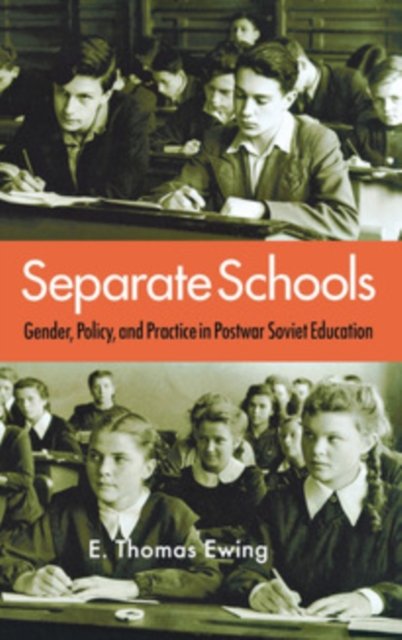
Separate Schools
Av E. Thomas Ewing, 2010.Del av serien NIU Series in Slavic, East European, and Eurasian Studies.
Gender, Policy, and Practice in Postwar Soviet Education
Starting in 1943, millions of children were separated into boys' and girls' schools in cities across the Soviet Union. The government sought to reinforce gender roles in a wartime context and to strengthen discipline and order by separating boys and girls into different classrooms. The program was a failure. Discipline further deteriorated in boys' schools, and despite intentions to keep the education equal, girls' schools experienced increased perceptions of academic inferiority, particularly in the subjects of math and science. The restoration of coeducation in 1954 demonstrated the power of public opinion, even in a dictatorship, to influence school policies. In the first full-length study of the program, Ewing examines this large-scale experiment across the full cycle of deliberating, advocating, implementing, experiencing, criticizing, and finally repudiating separate schools. Looking at the encounters of pupils in classrooms, policy objectives of communist leaders, and growing opposition to separate schools among teachers and parents, Ewing provides new insights into the last decade of Stalin's dictatorship. A comparative analysis of the Soviet case with recent efforts in the United States and elsewhere raises important questions. Based on extensive research that includes the archives of Uzbekistan and Kazakhstan, Separate Schools will appeal to historians of Russia, those interested in comparative education and educational history, and specialists in gender studies.
Ikke tilgjengelig for Klikk&Hent
Midlertidig tomt på lager
Bestillingsvare. Forventes sendt om ca 12 dager
Oppdag mer
Separate Schools
Av E. Thomas Ewing, 2010.Del av serien NIU Series in Slavic, East European, and Eurasian Studies.
Gender, Policy, and Practice in Postwar Soviet Education
Starting in 1943, millions of children were separated into boys' and girls' schools in cities across the Soviet Union. The government sought to reinforce gender roles in a wartime context and to strengthen discipline and order by separating boys and girls into different classrooms. The program was a failure. Discipline further deteriorated in boys' schools, and despite intentions to keep the education equal, girls' schools experienced increased perceptions of academic inferiority, particularly in the subjects of math and science. The restoration of coeducation in 1954 demonstrated the power of public opinion, even in a dictatorship, to influence school policies. In the first full-length study of the program, Ewing examines this large-scale experiment across the full cycle of deliberating, advocating, implementing, experiencing, criticizing, and finally repudiating separate schools. Looking at the encounters of pupils in classrooms, policy objectives of communist leaders, and growing opposition to separate schools among teachers and parents, Ewing provides new insights into the last decade of Stalin's dictatorship. A comparative analysis of the Soviet case with recent efforts in the United States and elsewhere raises important questions. Based on extensive research that includes the archives of Uzbekistan and Kazakhstan, Separate Schools will appeal to historians of Russia, those interested in comparative education and educational history, and specialists in gender studies.
Oppdag mer
Ikke tilgjengelig for Klikk&Hent
Midlertidig tomt på lager
Bestillingsvare. Forventes sendt om ca 12 dager
Ved å fullføre kjøpet aksepterer du kjøpsvilkårene.
Populært i samme kategori
Cultures of Educational Leadership

Culture, Education, and Community
Flere bøker i serien