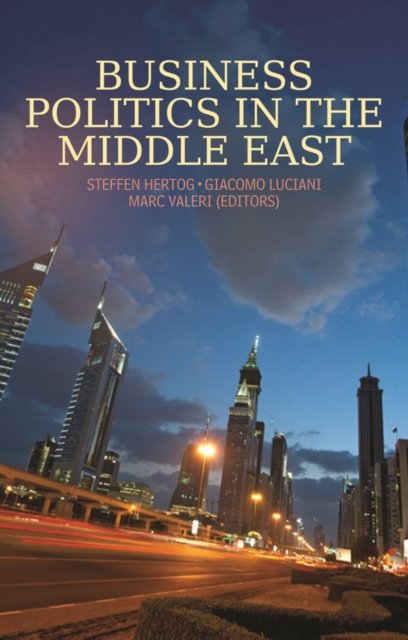
Business Politics in the Middle East
Redigert av Giacomo Luciani, Steffen Hertog, Marc Valeri, 2013.
Although most Arab countries remain authoritarian, many have undergone a restructuring of state-society relations in which lower- and middle-class interest groups have lost ground while big business has benefited in terms of its integration into policy-making and the opening of economic sectors that used to be state-dominated. Arab businesses have also started taking on aspects of public ser- vice provision in health, media and education that used to be the domain of the state; they have also become increasingly active in philanthropy. The 'Arab Spring,' which is likely to lead to a more pluralistic political order, makes it all the more important to understand business interests in the Middle East, a segment of society that on the one hand has often been close to the ancien regime, but on the other will play a pivotal role in a future social contract. Among the topics addressed by the authors are the role of business in recent regime change; the political outlook of businessmen; the consequences of economic liberalisation on the composition of business elites in the Middle East; the role of the private sec- tor in orienting government policies; lobbying of government by business interests and the mechanisms by which governments seek to keep businesses dependent on them.
Språk: Engelsk
Business Politics in the Middle East
Redigert av Giacomo Luciani, Steffen Hertog, Marc Valeri, 2013.
Although most Arab countries remain authoritarian, many have undergone a restructuring of state-society relations in which lower- and middle-class interest groups have lost ground while big business has benefited in terms of its integration into policy-making and the opening of economic sectors that used to be state-dominated. Arab businesses have also started taking on aspects of public ser- vice provision in health, media and education that used to be the domain of the state; they have also become increasingly active in philanthropy. The 'Arab Spring,' which is likely to lead to a more pluralistic political order, makes it all the more important to understand business interests in the Middle East, a segment of society that on the one hand has often been close to the ancien regime, but on the other will play a pivotal role in a future social contract. Among the topics addressed by the authors are the role of business in recent regime change; the political outlook of businessmen; the consequences of economic liberalisation on the composition of business elites in the Middle East; the role of the private sec- tor in orienting government policies; lobbying of government by business interests and the mechanisms by which governments seek to keep businesses dependent on them.
Språk: Engelsk
Ved å fullføre kjøpet aksepterer du kjøpsvilkårene.