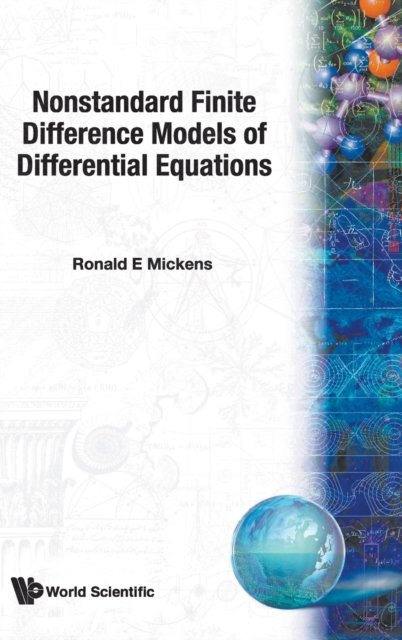
Nonstandard Finite Difference Models of Differential Equations
Redigert av Ronald E Mickens, 1993.
This book provides a clear summary of the work of the author on the construction of nonstandard finite difference schemes for the numerical integration of differential equations. The major thrust of the book is to show that discrete models of differential equations exist such that the elementary types of numerical instabilities do not occur. A consequence of this result is that in general bigger step-sizes can often be used in actual calculations and/or finite difference schemes can be constructed that are conditionally stable in many instances whereas in using standard techniques no such schemes exist. The theoretical basis of this work is centered on the concepts of “exact” and “best” finite difference schemes. In addition, a set of rules is given for the discrete modeling of derivatives and nonlinear expressions that occur in differential equations. These rules often lead to a unique nonstandard finite difference model for a given differential equation.
Språk: Engelsk
Nonstandard Finite Difference Models of Differential Equations
Redigert av Ronald E Mickens, 1993.
This book provides a clear summary of the work of the author on the construction of nonstandard finite difference schemes for the numerical integration of differential equations. The major thrust of the book is to show that discrete models of differential equations exist such that the elementary types of numerical instabilities do not occur. A consequence of this result is that in general bigger step-sizes can often be used in actual calculations and/or finite difference schemes can be constructed that are conditionally stable in many instances whereas in using standard techniques no such schemes exist. The theoretical basis of this work is centered on the concepts of “exact” and “best” finite difference schemes. In addition, a set of rules is given for the discrete modeling of derivatives and nonlinear expressions that occur in differential equations. These rules often lead to a unique nonstandard finite difference model for a given differential equation.
Språk: Engelsk
Ved å fullføre kjøpet aksepterer du kjøpsvilkårene.