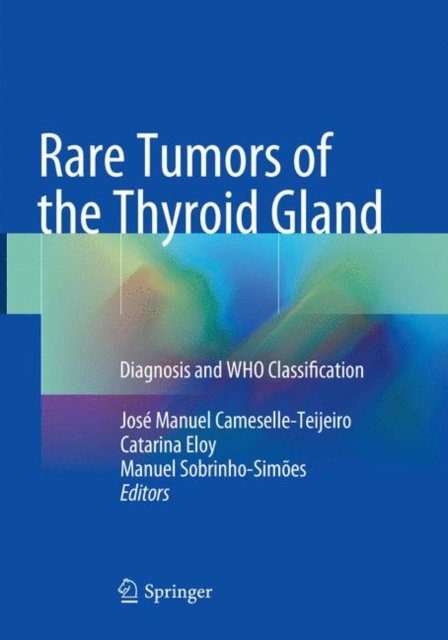
Rare Tumors of the Thyroid Gland
Redigert av Catarina Eloy, José Manuel Cameselle-Teijeiro, Manuel Sobrinho-Simões, 2018.
Diagnosis and WHO classification
This book documents the most important clinicopathological features of rare thyroid tumours with an emphasis (and ample documentation) on their histological and immunohistochemical aspects. Whenever necessary, namely for differential diagnosis and/or therapy purposes, molecular data are also highlighted. In order to understand the histogenesis of rare lesions and to be able to make a differential diagnosis, the editors use the WHO book for endocrine tumours (in preparation) as a framework for classifying thyroid tumours. In addition to characterizing the main histotypes of thyroid tumours, this book also provides detailed information on how to approach the diagnosis of tumours according to the major morphological/immunohistochemical characteristics, the predominant morphology and whether or not they are hereditary. This book is a valuable learning tool for those involved in the differential diagnosis of thyroid lesions.
Språk: Engelsk
Oppdag mer
Rare Tumors of the Thyroid Gland
Redigert av Catarina Eloy, José Manuel Cameselle-Teijeiro, Manuel Sobrinho-Simões, 2018.
Diagnosis and WHO classification
This book documents the most important clinicopathological features of rare thyroid tumours with an emphasis (and ample documentation) on their histological and immunohistochemical aspects. Whenever necessary, namely for differential diagnosis and/or therapy purposes, molecular data are also highlighted. In order to understand the histogenesis of rare lesions and to be able to make a differential diagnosis, the editors use the WHO book for endocrine tumours (in preparation) as a framework for classifying thyroid tumours. In addition to characterizing the main histotypes of thyroid tumours, this book also provides detailed information on how to approach the diagnosis of tumours according to the major morphological/immunohistochemical characteristics, the predominant morphology and whether or not they are hereditary. This book is a valuable learning tool for those involved in the differential diagnosis of thyroid lesions.
Oppdag mer
Språk: Engelsk
Ved å fullføre kjøpet aksepterer du kjøpsvilkårene.