Hopp til hovedinnholdet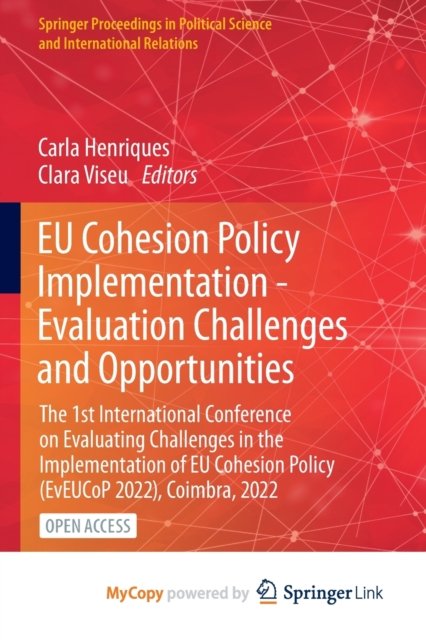
EU Cohesion Policy Implementation - Evaluation Challenges and Opportunities
Redigert av Henriques Carla Henriques, Viseu Clara Viseu, 2022.
The 1st International Conference on Evaluating Challenges in the Implementation of EU Cohesion Policy (EvEUCoP 2022), Coimbra, 2022
Part I. Mid-term/terminal assessment: Data Envelopment Analysis approaches.- Chapter 1. Evaluating the reasons behind the inefficient implementation of ERDF devoted to R&I in SMEs (Carla Henriques).- Chapter 2. Are ERDF devoted to boosting ICT in SMEs inefficient? Insights through different DEA models (Carla Henriques).- Chapter 3. Are ERDF devoted to boosting ICT in SMEs inefficient? Further insights through the joint use of DEA with SFA models (Carla Henriques).- Chapter 4. Python implementation of the Value-Based DEA method (António Trigo).- Chapter 5. Are ERDF efficient in strengthening the switch to a Low-Carbon Economy? Some Insights with Value-Based Data Envelopment Analysis (Maria Gouveia).- Part II. Ex-post assessment: Meta-analysis.- Chapter 6. Firm competitiveness, specialization, and employment growth: territorial level Relationships (Federico Fantechi).- Chapter 7. The youth guarantee in Eastern Europe. A systematic review (Gabriela Neagu).- Part III. Methodologies for supporting the selection of projects.- Chapter 8. Smart and Sustainable Scheduling of Charging Events for Electric Buses (Padraigh Jarvis).- Chapter 9. Multiple impacts of energy efficiency technologies in Portugal (Marcos Tenente).- Part IV. Case studies.- Chapter 10. EU Operational Programmes Reporting: From Basics to Practices (Ana Amaro).- Chapter 11. European structural and investment funds 2021-2027: prediction analysis based on machine learning models (Victor Santos).- Chapter 12. Technology serving justice (Ana Paula Lopes)
PocketEngelsk
499,-
Ikke tilgjengelig for Klikk&Hent
Utsolgt på nettlager
EU Cohesion Policy Implementation - Evaluation Challenges and Opportunities
Redigert av Henriques Carla Henriques, Viseu Clara Viseu, 2022.
The 1st International Conference on Evaluating Challenges in the Implementation of EU Cohesion Policy (EvEUCoP 2022), Coimbra, 2022
Part I. Mid-term/terminal assessment: Data Envelopment Analysis approaches.- Chapter 1. Evaluating the reasons behind the inefficient implementation of ERDF devoted to R&I in SMEs (Carla Henriques).- Chapter 2. Are ERDF devoted to boosting ICT in SMEs inefficient? Insights through different DEA models (Carla Henriques).- Chapter 3. Are ERDF devoted to boosting ICT in SMEs inefficient? Further insights through the joint use of DEA with SFA models (Carla Henriques).- Chapter 4. Python implementation of the Value-Based DEA method (António Trigo).- Chapter 5. Are ERDF efficient in strengthening the switch to a Low-Carbon Economy? Some Insights with Value-Based Data Envelopment Analysis (Maria Gouveia).- Part II. Ex-post assessment: Meta-analysis.- Chapter 6. Firm competitiveness, specialization, and employment growth: territorial level Relationships (Federico Fantechi).- Chapter 7. The youth guarantee in Eastern Europe. A systematic review (Gabriela Neagu).- Part III. Methodologies for supporting the selection of projects.- Chapter 8. Smart and Sustainable Scheduling of Charging Events for Electric Buses (Padraigh Jarvis).- Chapter 9. Multiple impacts of energy efficiency technologies in Portugal (Marcos Tenente).- Part IV. Case studies.- Chapter 10. EU Operational Programmes Reporting: From Basics to Practices (Ana Amaro).- Chapter 11. European structural and investment funds 2021-2027: prediction analysis based on machine learning models (Victor Santos).- Chapter 12. Technology serving justice (Ana Paula Lopes)
499,-
PocketEngelsk
Ikke tilgjengelig for Klikk&Hent
Utsolgt på nettlager