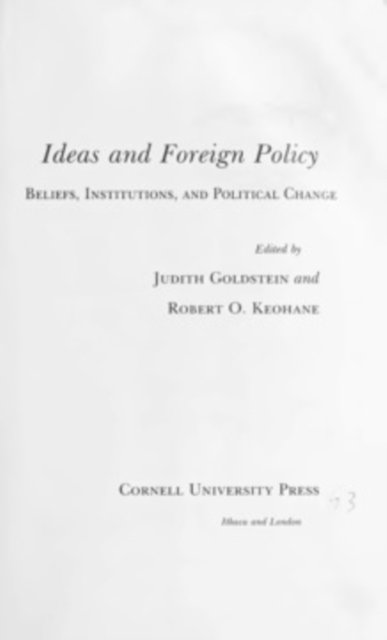
Ideas and Foreign Policy
Redigert av Judith Goldstein, Robert O. Keohane, 1993.Del av serien Cornell Studies in Political Economy.
Beliefs, Institutions, and Political Change
Do people's beliefs help to explain foreign policy decisions, or is political activity better understood as the self-interested behavior of key actors? The collaborative effort of a group of distinguished scholars, this volume breaks new ground in demonstrating how ideas can shape policy, even when actors are motivated by rational self-interest.
After an introduction outlining a new framework for approaching the role of ideas in foreign policy making, well-crafted case studies test the approach. The function of ideas as "road maps" that reduce uncertainty is examined in chapters on human rights, decolonialization, the creation of socialist economies in China and Eastern Europe, and the postwar Anglo-American economic settlement. Discussions of parliamentary ideas in seventeenth-century England and of the Single European Act illustrate the role of ideas in resolving problems of coordination. The process by which ideas are institutionalized is further explored in chapters on the Peace of Westphalia and on German and Japanese efforts to cope with contemporary terrorism.
Ikke tilgjengelig for Klikk&Hent
Midlertidig tomt på lager
Bestillingsvare. Forventes sendt om ca 11 dager
Oppdag mer
Ideas and Foreign Policy
Redigert av Judith Goldstein, Robert O. Keohane, 1993.Del av serien Cornell Studies in Political Economy.
Beliefs, Institutions, and Political Change
Do people's beliefs help to explain foreign policy decisions, or is political activity better understood as the self-interested behavior of key actors? The collaborative effort of a group of distinguished scholars, this volume breaks new ground in demonstrating how ideas can shape policy, even when actors are motivated by rational self-interest.
After an introduction outlining a new framework for approaching the role of ideas in foreign policy making, well-crafted case studies test the approach. The function of ideas as "road maps" that reduce uncertainty is examined in chapters on human rights, decolonialization, the creation of socialist economies in China and Eastern Europe, and the postwar Anglo-American economic settlement. Discussions of parliamentary ideas in seventeenth-century England and of the Single European Act illustrate the role of ideas in resolving problems of coordination. The process by which ideas are institutionalized is further explored in chapters on the Peace of Westphalia and on German and Japanese efforts to cope with contemporary terrorism.
Oppdag mer
Ikke tilgjengelig for Klikk&Hent
Midlertidig tomt på lager
Bestillingsvare. Forventes sendt om ca 11 dager
Ved å fullføre kjøpet aksepterer du kjøpsvilkårene.