Hopp til hovedinnholdet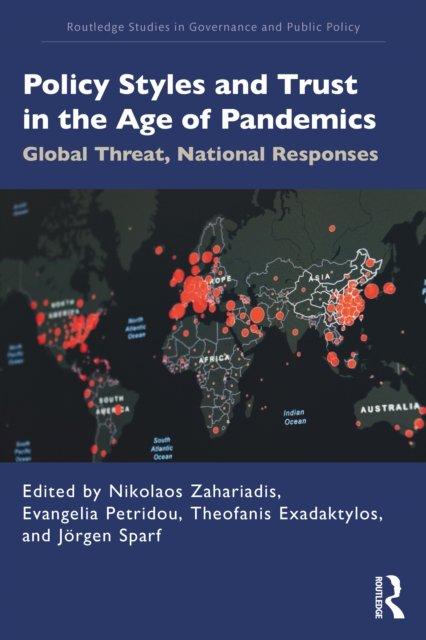
Policy Styles and Trust in the Age of Pandemics
Redigert av Evangelia Petridou, Jorgen Sparf, Nikolaos Zahariadis, Theofanis Exadaktylos, 2022.Del av serien Routledge Studies in Governance and Public Policy.
Global Threat, National Responses
This book explores the reasons behind the variation in national responses to the COVID-19 pandemic. In doing so, it furthers the policy studies scholarship through an examination of the effects of policy styles on national responses to the pandemic.
Despite governments being faced with the same threat, significant variation in national responses, frequently of contradictory nature, has been observed. Implications about responses inform a broader class of crises beyond this specific context. The authors argue that trust in government interacts with policy styles resulting in different responses and that the acute turbulence, uncertainty, and urgency of crises complicate the ability of policymakers to make sense of the problem. Finally, the book posits that unless there is high trust between society and the state, a decentralized response will likely be disastrous and concludes that while national responses to crises aim to save lives, they also serve to project political power and protect the status quo.
This text will be of key interest to scholars and students of public policy, public administration, political science, sociology, public health, and crisis management/disaster management studies.
Språk: Engelsk
569,-
Ikke tilgjengelig for Klikk&Hent
Midlertidig tomt på lager
Bestillingsvare. Forventes sendt om ca 10 dager
Oppdag mer
Policy Styles and Trust in the Age of Pandemics
Redigert av Evangelia Petridou, Jorgen Sparf, Nikolaos Zahariadis, Theofanis Exadaktylos, 2022.Del av serien Routledge Studies in Governance and Public Policy.
Global Threat, National Responses
This book explores the reasons behind the variation in national responses to the COVID-19 pandemic. In doing so, it furthers the policy studies scholarship through an examination of the effects of policy styles on national responses to the pandemic.
Despite governments being faced with the same threat, significant variation in national responses, frequently of contradictory nature, has been observed. Implications about responses inform a broader class of crises beyond this specific context. The authors argue that trust in government interacts with policy styles resulting in different responses and that the acute turbulence, uncertainty, and urgency of crises complicate the ability of policymakers to make sense of the problem. Finally, the book posits that unless there is high trust between society and the state, a decentralized response will likely be disastrous and concludes that while national responses to crises aim to save lives, they also serve to project political power and protect the status quo.
This text will be of key interest to scholars and students of public policy, public administration, political science, sociology, public health, and crisis management/disaster management studies.
Oppdag mer
569,-
Språk: Engelsk
Ikke tilgjengelig for Klikk&Hent
Midlertidig tomt på lager
Bestillingsvare. Forventes sendt om ca 10 dager
569,-
Ved å fullføre kjøpet aksepterer du kjøpsvilkårene.