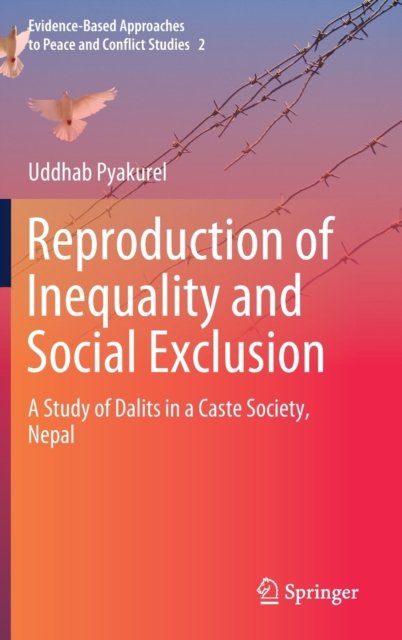
Reproduction of Inequality and Social Exclusion
Av Uddhab Pyakurel, 2021.Del av serien Evidence-Based Approaches to Peace and Conflict Studies.
A Study of Dalits in a Caste Society, Nepal
This book is a detailed account of how hierarchy has been maintained historically by the Nepali state, affirming the uniqueness of a caste-based social order by bringing outsiders, especially ethnic groups and religious minorities, into the caste fold. Focusing on the contemporary state of Dalits, the community that was and is put at the bottom of a very hierarchical social order in Nepal, the author argues that the traditional caste-based social order is still prevalent in the "new" Nepal even after the recent socio-political and constitutional changes. Illustrated by scientifically employed and interpreted data mainly in the three sectors of education, politics and employment, the book postulates that people who were and are born into the "high caste" still have more access to the resources and opportunities available in society in comparison with those born into the "lower" caste. It further argues that although reservation policies are in place to address social exclusion, these could not bring expected outcomes mainly due to the lack of engagement, if not ignorance, of both dominant groups and the community in the margin. The absence of clarity among political actors on the positive discrimination and affirmative actions has contributed to backtracking the recently created space in line with "inclusive Nepal".
Språk: Engelsk
Ikke tilgjengelig for Klikk&Hent
Midlertidig tomt på lager
Bestillingsvare. Forventes sendt om ca 20 dager
Oppdag mer
Reproduction of Inequality and Social Exclusion
Av Uddhab Pyakurel, 2021.Del av serien Evidence-Based Approaches to Peace and Conflict Studies.
A Study of Dalits in a Caste Society, Nepal
This book is a detailed account of how hierarchy has been maintained historically by the Nepali state, affirming the uniqueness of a caste-based social order by bringing outsiders, especially ethnic groups and religious minorities, into the caste fold. Focusing on the contemporary state of Dalits, the community that was and is put at the bottom of a very hierarchical social order in Nepal, the author argues that the traditional caste-based social order is still prevalent in the "new" Nepal even after the recent socio-political and constitutional changes. Illustrated by scientifically employed and interpreted data mainly in the three sectors of education, politics and employment, the book postulates that people who were and are born into the "high caste" still have more access to the resources and opportunities available in society in comparison with those born into the "lower" caste. It further argues that although reservation policies are in place to address social exclusion, these could not bring expected outcomes mainly due to the lack of engagement, if not ignorance, of both dominant groups and the community in the margin. The absence of clarity among political actors on the positive discrimination and affirmative actions has contributed to backtracking the recently created space in line with "inclusive Nepal".
Oppdag mer
Språk: Engelsk
Ikke tilgjengelig for Klikk&Hent
Midlertidig tomt på lager
Bestillingsvare. Forventes sendt om ca 20 dager
Ved å fullføre kjøpet aksepterer du kjøpsvilkårene.