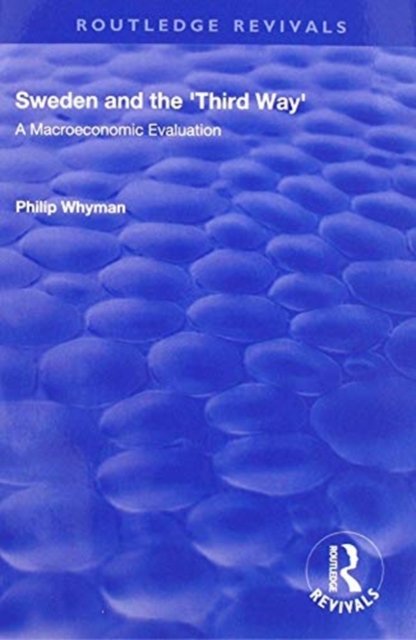
Sweden and the ''Third Way''
Av Philip Whyman, 2019.Del av serien Routledge Revivals.
A Macroeconomic Evaluation
This title was first published in 2003.The creation of a 'Third Way' between unfettered capitalism and old-style Keynesian-corporatist forms of social democracy has become the driving force behind the policy programmes of many left-of-centre political parties in the industrialised nations of the world today. Sweden and the 'Third Way' critically evaluates this 'new' social democracy by examining the profound shift in Swedish political economy from being the prototype old-style social democracy towards the 'Third Way' synthesis of neo-liberalism and elements of traditional social democracy. Philip Whyman evaluates internal and external challenges to Swedish macroeconomic policy - including globalisation, European integration, post-Fordist technological change and the relative empowerment of capital - to discover the extent to which national economic autonomy is constrained. Furthermore, he considers the plausibility of revising the core elements of the traditional 'Swedish Model' as an alternative to the prevailing macroeconomic platform.
Språk: Engelsk
Ikke tilgjengelig for Klikk&Hent
Midlertidig tomt på lager
Bestillingsvare. Forventes sendt om ca 10 dager
Oppdag mer
Sweden and the ''Third Way''
Av Philip Whyman, 2019.Del av serien Routledge Revivals.
A Macroeconomic Evaluation
This title was first published in 2003.The creation of a 'Third Way' between unfettered capitalism and old-style Keynesian-corporatist forms of social democracy has become the driving force behind the policy programmes of many left-of-centre political parties in the industrialised nations of the world today. Sweden and the 'Third Way' critically evaluates this 'new' social democracy by examining the profound shift in Swedish political economy from being the prototype old-style social democracy towards the 'Third Way' synthesis of neo-liberalism and elements of traditional social democracy. Philip Whyman evaluates internal and external challenges to Swedish macroeconomic policy - including globalisation, European integration, post-Fordist technological change and the relative empowerment of capital - to discover the extent to which national economic autonomy is constrained. Furthermore, he considers the plausibility of revising the core elements of the traditional 'Swedish Model' as an alternative to the prevailing macroeconomic platform.
Oppdag mer
Språk: Engelsk
Ikke tilgjengelig for Klikk&Hent
Midlertidig tomt på lager
Bestillingsvare. Forventes sendt om ca 10 dager
Ved å fullføre kjøpet aksepterer du kjøpsvilkårene.